Sep 29, 2026
Importing a Crane Truck into Chile: Euro VI Started on 5 January 2026, Not Later
Chile's Euro VI rule for heavy vehicles took effect on 5 January 2026 under Decreto 50/2023 — and certification has to be started on the Chilean side, by a manufacturer, assembler or importer.
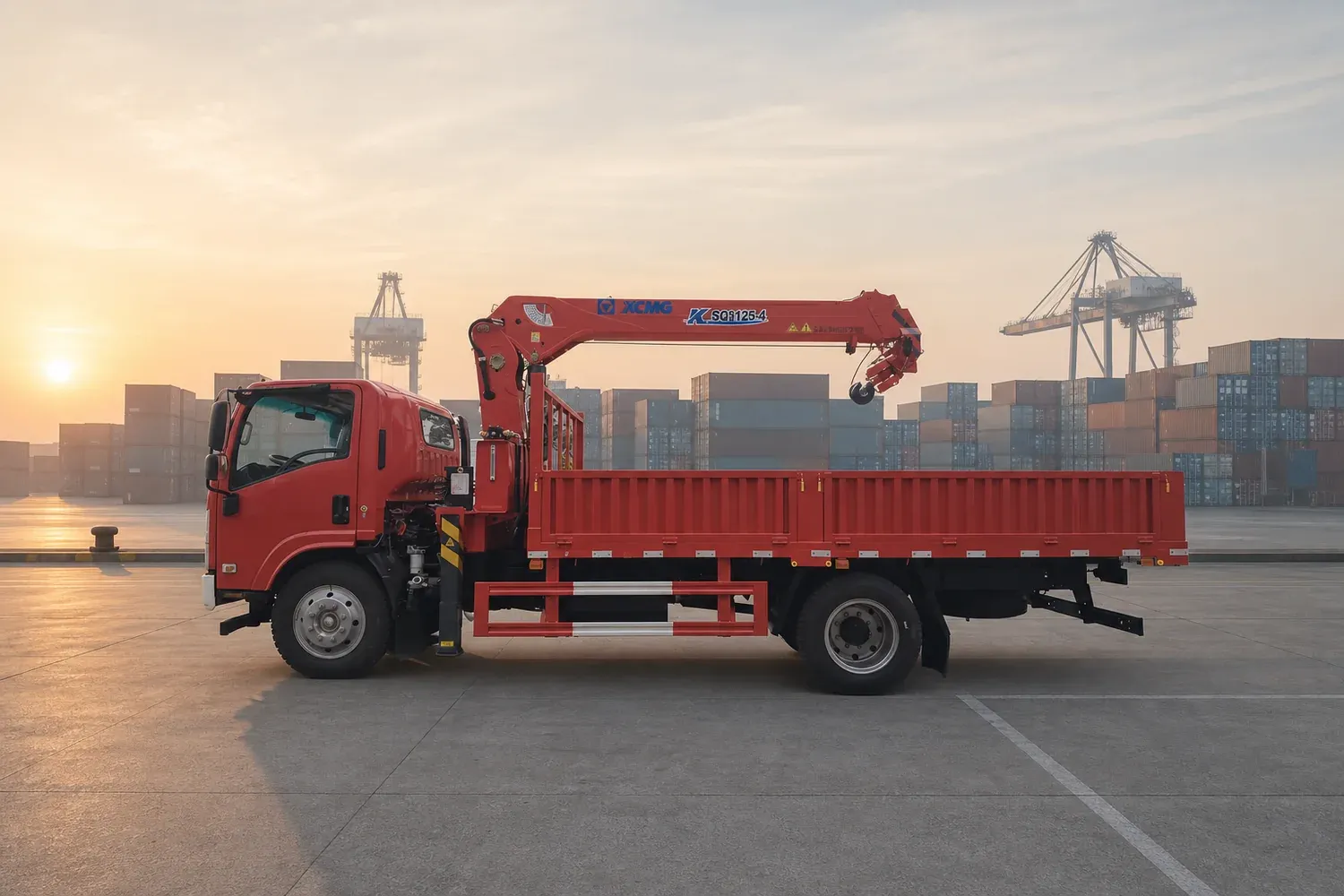
Chile's heavy-vehicle emission rule is not a proposal and not a phase-in. It took effect on 5 January 2026 — eight months ago.
If you are still receiving quotations for a Euro V chassis into Chile, those quotations describe a vehicle that can no longer be registered for the first time. The engine is not the issue at the port. It is the issue at the registration office, and it cannot be repaired there.
The rule, and the clause that sets the date
Decreto 50/2023 (Ministry of the Environment) was published on 5 July 2024 and added Article 8 quáter to DS 55/1994, Chile's vehicle emission framework. Its transition clause runs the new article from 18 months after publication — that is 5 January 2026.
From that date, a heavy vehicle applying for first registration (primera inscripción) in Chile's vehicle registry must meet Euro VI or the equivalent US EPA standard.
The regulated limits cover CO, HCNM, NOx, particulate mass, HCT, CH4, NH3 and particle number (NP). Compliance is demonstrated by one of two routes:
- US EPA CFR-40 Part 1065 procedures, or
- WHTC / WHSC cycles under Regulation (CE) No 595/2009 (the Euro VI regulation).
"Heavy" is defined by gross vehicle weight above 3,860 kg, with trucks and tractor units treated as their own class. A crane truck on a commercial chassis is squarely inside that definition.
One documented conflict, and how we resolved it. The Environment Ministry's own press release announcing the standard stated that the new limits applied from 5 July 2024. That is inconsistent with the decree's own transition clause. We take the legislative text as authoritative: 5 January 2026. Chilean law-firm analyses and industry reporting read it the same way. If a supplier shows you the press release as evidence the rule started earlier, ask them for the decree article.
In engineering terms, Euro VI here means a DPF plus SCR combination. That is not an option package.
Certification runs through 3CV — and it cannot be filed from China
The emission certification is issued by the Ministry of Transport through 3CV (Centro de Control y Certificación Vehicular), under DS 55/1994, following the procedure in Resolución Exenta 2.113/2004.
The single most important sentence in the whole process: applications may be made only by manufacturers, assemblers, importers, or their representative. There is no route for an overseas exporter to file. Certification therefore has to be started on the Chilean side, and started before production is finished — not after the truck sails.
What the applicant has to produce:
Step | Requirement |
|---|---|
Application | Form per Annex I of Res. Ex. 2.113 |
Technical data | Annexes II, III, IV, V, submitted at least 10 days before the vehicle is presented for inspection |
Engine evidence | A technical report from an independent laboratory or certification body, covering a representative engine (same type or same engine family), showing the test method is one of those listed in DS 55/1994 |
Vehicle data | Technical specification sheet for the vehicles that will receive the certified engine |
Physical vehicle | A representative vehicle of the model must be delivered to 3CV for verification, and collected afterwards |
3CV issues its finding within 7 working days of the vehicle being presented. Absent an objection, certification is granted and the DS 55 certificates may be issued.
Three details that decide whether your programme is realistic:
- Certification stays valid for as long as the vehicle is unchanged. Change the crane, the chassis rating or the engine family and you are back at the counter.
- Certification also checks that the vehicle is built from new, unused parts and components (fabricación con partes y piezas nuevas sin uso). A rebuilt or refurbished route does not survive this test.
- The seller has a statutory duty to hand the buyer a certificate stating engine brand, model and serial number, plus vehicle brand, model, type, year of manufacture, colour, VIN and chassis number. That document is part of the delivery, not a favour.
Filing is at 3CV, Vicente Reyes N° 198, Maipú, Santiago Metropolitan Region, Monday to Friday 09:00–14:00, or by PDF to [email protected].
Fuel is not the constraint in Chile
Nationwide automotive diesel in Chile is capped at 10 ppm sulfur. That is ultra-low-sulfur diesel, and it is what the Euro VI aftertreatment is specified against.
The legislative record has two dates for the switchover. Decreto 50's own recitals trace it through Ministry of Energy exempt decrees — Decree 140 set 1 October 2024, Decree 149 moved it, and Decree 173 revoked 149 and confirmed 1 October 2024. A separate official instrument, Decreto 152 Exento, records national ≤10 ppm supply from 30 March 2025. Under either reading, the fuel has been in the market for well over a year.
The practical consequence for a buyer: there is no fuel-quality objection to running a Euro VI DPF and SCR engine in Chile, which is not something every market in the region can say.
The risk simply moves downstream — to AdBlue (ARLA 32, 32.5% urea) supply and to fleet maintenance discipline: DPF regeneration cycles, NOx sensor care, and urea pump and injector servicing. Those are operator problems, not import problems, and they are worth planning for before the trucks arrive, not after.
Used trucks: there is a door, and we are not going to walk you through it
Ley 18.483, Article 21 prohibits importing used vehicles from free zones or from abroad. The text explicitly covers passenger cars, motorcycles and trucks (camiones).
The second paragraph of the same article exempts vehicles intended for special uses other than transport itself. The list includes ambulances, hearses, fire trucks, coches grúas (crane vehicles), concrete mixers, workshop vehicles, breakdown vehicles and off-road transport vehicles, plus "other similar special-purpose vehicles".
On paper, that reads as a channel for a used crane truck. We are not treating it as one yet, for three reasons:
- We do not hold the current consolidated text of Article 21. The legal report we relied on dates from 2014. A bill filed in September 2026 (Boletín N° 18.607-15) proposes liberalising used-vehicle imports, which tells you the present position is still restrictive — and it is not yet law.
- The special-use list is Customs' administrative interpretation, and administrative interpretations can be overturned.
- A used vehicle that clears the import gate still has to clear the emission gate. Get the Article 21 analysis wrong and you own a truck that cannot be first-registered.
So: we will not promise that a used crane truck can be imported or registered in Chile. We build new, and the new-vehicle route through 3CV is the one we can describe precisely.
What we will not tell you
We will not give you a China–Chile FTA duty rate for HS 8704 or 8705. The FTA has been in force since 3 October 2006 (2019 amending protocol), and it removes tariffs on Chinese-origin goods across four staging categories — one, five and ten-year steps to zero — plus an exclusion list. Whether crane trucks sit inside that exclusion list has to be checked line by line against Chile's tariff. We are checking. Anyone who quotes you a zero-duty figure without naming the HS line has guessed at it.
We will not quote you the vehicle import special tax. DL 825, Article 43 bis applies to vehicles whose normal use is passenger or freight transport, new and used alike. It is computed on customs value as (displacement in cc × 0.03 − 45) percent, with a cap that stood at US$7,503.55 and has been indexed since 1999, with a 10%-per-year value reduction for older model years capped at 50%. Run the formula on a 4.5–5.2 litre mid truck and it returns around 111% at 5,193 cc — above the cap, so the cap is what would bind.
That arithmetic is ours and it comes from a 2014 legal report. Whether the tax is actually levied on imported trucks, and what the current parameters are, has to be confirmed by your customs agent (agente de aduana) shipment by shipment. We will not put an unverified number into a quotation.
We will not promise 3CV approval. The certifier decides. What we can do is prepare the technical file to the standards that apply and support the applicant through the process.
We will not invent ports, transit times or trade terms for Chile. We did not verify them, and a plausible-sounding number is worse than a blank.
What to send us
Four things and a Chile quotation becomes a real conversation:
- GVW and chassis — the 3,860 kg threshold decides which certification path applies.
- Crane model and configuration — this is what gets locked into the certified specification, and it cannot drift afterwards.
- Who will be the applicant on the Chilean side — a manufacturer, assembler, importer or their representative. Certification cannot be initiated from China.
- The duty cycle — copper and lithium haulage put different demands on a 10–16 tonne crane than general freight does.
Chile drives on the right and takes left-hand-drive vehicles, the same as China, so there is no steering conversion in this programme.
Official references
- Decreto 50/2023 (Ministerio del Medio Ambiente), amending DS 55/1994 — Article 8 quáter and transition clause (published 5 July 2024)
- Subtrans / 3CV — Certificación de Emisiones Vehículos Pesados (heavy-vehicle emission certification)
- ChileAtiende procedure 24501 — Certificación de emisiones de camiones y tracto camiones (updated 24 August 2026)
- Resolución Exenta 2.113/2004 (Ministry of Transport) — certification procedure, Annexes I–V
- Ley 18.483, Article 21 — used-vehicle import prohibition and the special-use exemption (text as cited in BCN legal report, 2014)
- Cámara de Diputados, Boletín N° 18.607-15 — bill on used-vehicle imports, filed 3 September 2026 (not law)
- Aduana de Chile — Tratado de Libre Comercio Chile–China; DL 825 Article 43 bis as cited in BCN legal report (2014 parameters)
Rules and dates are stated as published at the date of writing. Import and emission rules change. Confirm the current position with your Chilean importer and customs agent before you commit to a build.
Need a crane truck specified for Chile? Message us on WhatsApp at +86 158 0912 4321 and tell us the market and the machine.