Oct 13, 2026
Cold Start, Hydraulic Oil and the First Winter
A crane truck specified in a warm market and delivered into a continental winter is not a machine that fails. It is a machine that was never specified for where it went.
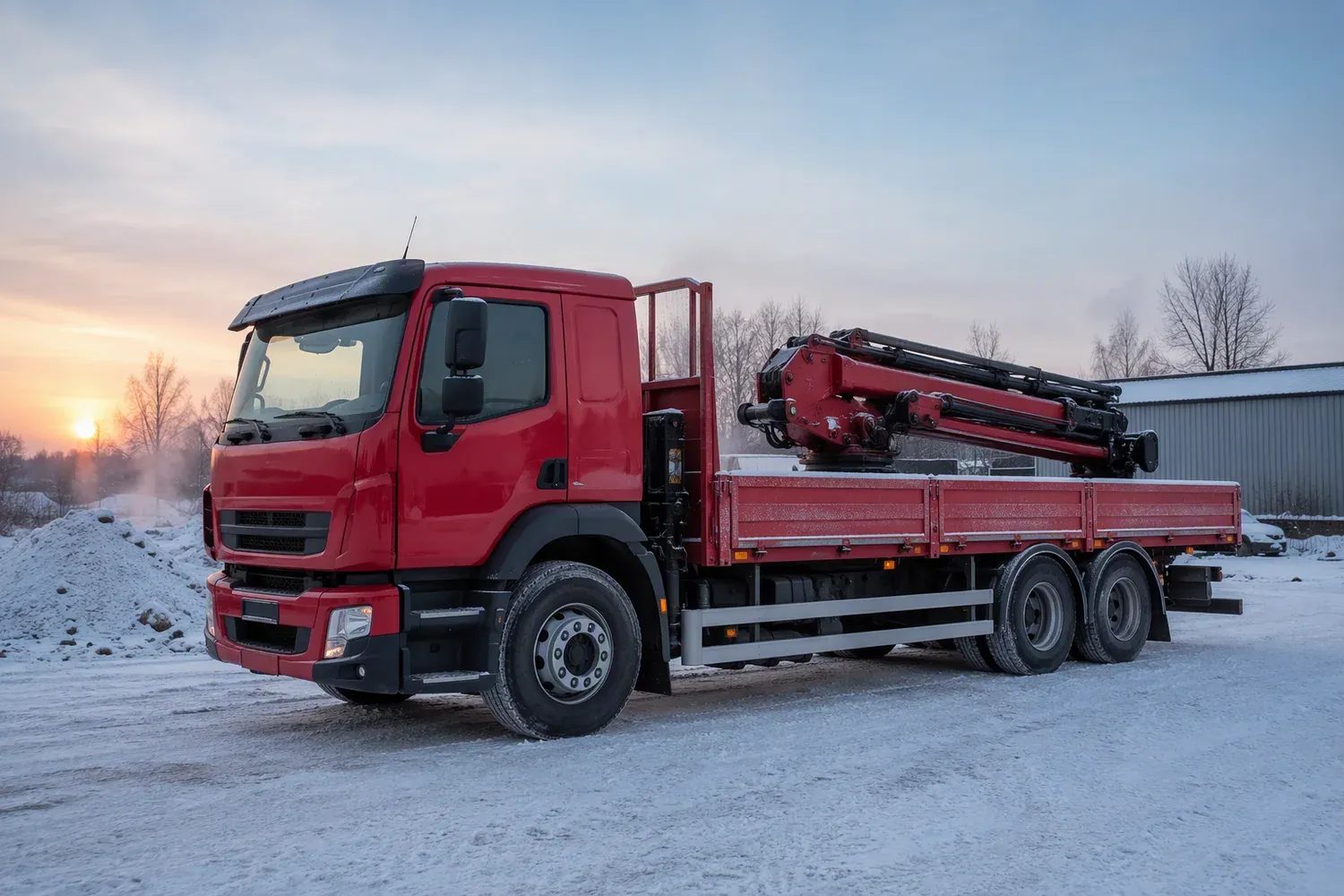
A crane truck specified in a warm market and delivered into a continental winter is not a machine that fails. It is a machine that was never specified for where it went.
This is not a story about quality. It is a story about four fluids and two components, and about a conversation that has to happen before the production slot is booked, because two of the six items are decided at the factory and cannot be fixed at the destination without cost.
The four fluids
Engine oil. The SAE grade on the can carries two numbers, and they do different jobs. The first, with the W, is the cold-flow rating; the second is the rating at operating temperature. A grade chosen for a hot market can be perfectly correct there and still be the wrong choice where the engine has to turn over at a temperature the oil was never asked to handle. The grade that applies to your specific engine is issued with the machine's manual and confirmed on the order — we do not publish a generic grade for the range, because the engine fitted is decided per order.
Hydraulic oil. This is the one that catches buyers out, because the crane is the newest and most expensive part of the truck and its pump is the most sensitive thing on it. Hydraulic oil is graded by viscosity, and viscosity is measured at a reference temperature — so a grade that circulates correctly once the machine is warm can be far too thick to be drawn by the pump on a cold morning. The pump manufacturer publishes the viscosity range the pump will accept, and the cold end of that range is the number that decides your oil choice. A crane that is started cold and worked immediately is asking the pump to draw oil it cannot draw. The answer is not a different crane; it is the right grade, and a warm-up procedure that respects it.
Diesel. Diesel waxes as it cools. Winter-grade diesel is blended for a lower cloud point, and the blend available at your site in January is a fact about your fuel supply, not about the truck. Where the supply shifts between seasons, the machine's fuel system — filtration and, if fitted, fuel pre-heating — is what carries the difference. Two trucks built to the same specification can behave completely differently across one winter because one buyer asked about the fuel and the other did not.
Urea, where the truck uses it. A Euro VI-class engine with selective catalytic reduction runs on a urea reagent, and that reagent freezes at around minus 11 °C. That is a property of the reagent itself, not a defect. Systems are designed around it with tank heaters and thaw cycles, but it does mean that the reagent's supply and its behaviour in a hard freeze belong on the specification sheet, not in the after-sales file. Two models in our current listings carry emission labels at this level — for example the grab refuse truck on SINOTRUK Wangpai with lifting axle (TMG-WP2506, Euro VI, 220 hp Yuchai) — and where that is the case the reagent question comes with it.
The two components
The battery. A battery's ability to deliver cranking current falls as temperature falls, while the engine's demand for that current rises. A battery sized against a warm-climate duty cycle can be adequate on paper and marginal in January. Cranking capacity is specified, not inherited, and it is cheapest to specify it once.
Pre-heating. Depending on the engine, cold-start assistance can take the form of an intake air heater, a coolant pre-heater, or a fuel heater — and not every engine has every option. This is a factory-side decision. It is also the one item on this list that is genuinely difficult and expensive to add after the truck has landed.
What we ask before we build
- The lowest ambient temperature the truck will be started at, in numbers.
- Whether it will be parked indoors or outdoors.
- The diesel grade available at the site in winter, and whether the supply changes seasonally.
- Whether the truck works year-round or is parked for the cold season.
- Whether the machine is expected to work immediately on start-up, or can be warmed first.
Those five answers decide the oil grades, the battery and the pre-heat package. They cost nothing to answer and they are much cheaper than correcting.
What we will not tell you
- We will not print a single oil grade and call it the range's answer. The right grade follows the engine and the climate you name.
- We will not promise a starting temperature for a specific model. We do not have the factory's cold-start data for every build, and a number invented for a web page is worse than no number.
- We will not claim your local diesel in January is a particular grade. That is a fact about your supply.
- We will not describe a cold-start package as unnecessary. Where the destination is cold, it is part of the specification and it is priced as such.
What to send us
- Destination and the coldest month's temperature range.
- The job: tonnage, boom type, and how many hours a day the crane runs.
- Whether the body tips or carries only.
- Whether the fleet already runs in the same climate — if so, which oils you are using there.
Our quoted models and figures are those listed on this site, reviewed 1 October 2026. The truck-mounted crane and grab truck listings carry the range, and the emission-label question is covered in a separate article. Buyers working a continental winter may also want the Kazakhstan guide, which is where this question comes up most often.
Left-hand drive is our standard build; right-hand drive is available on request.
Send us the five lines on WhatsApp and we will come back with the oil grades, the battery and the pre-heat package that fit where the truck is going.