Oct 14, 2026
Mounting Hardware and the Packing List
Most post-delivery disputes are not about the crane. They are about a hose, a fitting, a pad or a manual. The lines that must appear on your packing list, and the four checks on the machine.
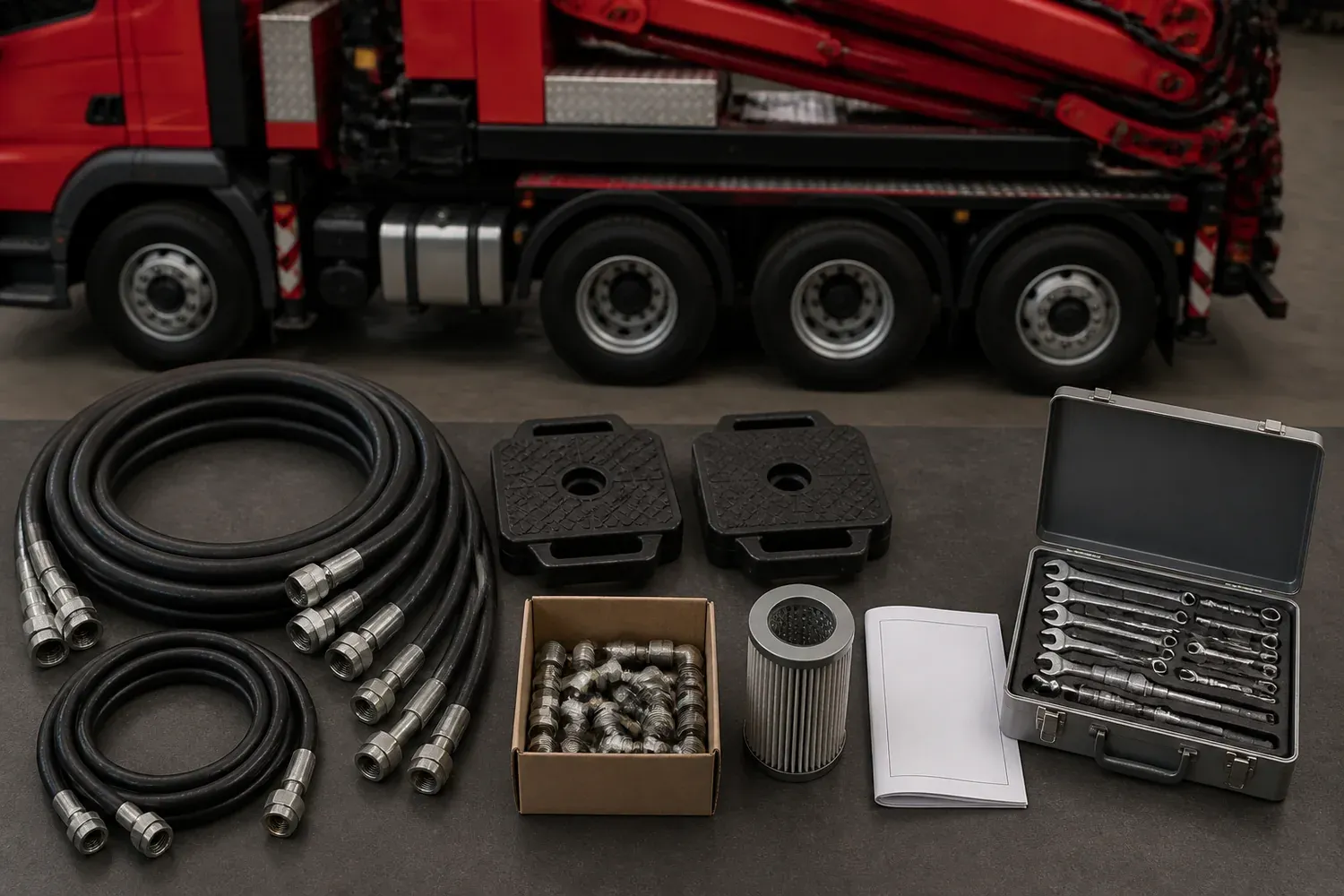
Ask a hundred crane truck buyers where their first dispute came from after delivery and most will not say "the crane". They will say a hose, a pad, a fitting, a manual, or a plate — the small ironwork around the machine.
That is not a coincidence, and it is not a quality problem. It is a documentation problem. The crane is the part everyone negotiates over; the small items are the part nobody writes down, so there is nothing to check against on arrival.
We ship complete trucks — so this is inspection, not assembly
Our crane trucks and grab trucks leave as complete vehicles: chassis, crane, body, hydraulic system, controls. Nothing on our listing is a kit that gets assembled at destination.
That changes what the receiving check is for. It is not an assembly job; it is a receiving inspection against a document. Which means the document is the deliverable that has to be right, and a buyer who has not asked for it in advance has nothing to inspect against.
The lines that must be on your packing list
We do not publish a single house packing list, because the contents are set per order and a generic list would be a promise about a truck we have not built. What we will do is name the lines that must appear on yours, so that you can check them:
Line | Why it decides the first week |
|---|---|
Hydraulic hose ends — thread standard | The most expensive small item to get wrong. Fittings are made to more than one thread standard, and a fitting that does not match the local supply means a hose made up locally, or a part shipped. State the standard your service network uses and require it on the order. |
Spare hose and fitting set | A single set in the machine's own standards removes the "we will order it" gap from your first breakdown. |
Outrigger pads or mats | Ground conditions at the job site, not the machine, decide whether these are needed on day one. |
Control levers and their linkage | Including how the crane is operated when standing away from the base — and what that unit is. |
First-service kit | Filters and the consumables specified for the machine's first service interval. |
Operation and parts documentation | In the language the operators will actually read, together with the parts identification needed to order a wearing part by number rather than by photograph. |
Two further lines belong on the list for a different reason — not because they are shipped, but because they are the identification the whole warranty rests on: the crane's own serial plate and the chassis VIN, recorded on the same document. If a claim is ever needed, the two numbers have to be able to be matched to the same truck.
What to check on the machine itself
The packing list covers what travels with the truck. The receiving inspection covers what was done to it, and four items are worth a torque check and a look rather than a signature:
- Subframe and crane mounting bolts — checked and recorded, not assumed tight.
- Power take-off and pump drive — engagement, alignment, and whether the drive is protected.
- Hydraulic hose routing — every run that touches a chassis edge or crosses a hot surface needs protection, because abrasion failure is a routing problem, not a hose problem.
- Oil tank, suction and return filtration — the level and the filter element as delivered, before the first working day.
None of these is controversial. They are simply not usually written down, and an inspection with no written standard becomes a conversation about opinions.
What we will not tell you
- We will not issue a generic packing list. The list for your truck is issued with your order and matches your proforma invoice. A web page cannot do that job.
- We will not claim a particular thread standard is universal. It depends on the machine and on what your service network stocks — which is why we ask.
- We will not print torque figures, oil grades or service intervals here. Those come from the machine's own documentation, and inventing them for a web page is how a machine gets damaged by its own manual.
- We will not describe the truck as a kit. It arrives complete. If a supplier is describing your order as a kit with assembly at destination, that is a different kind of transaction.
What to send us
- The thread standard your service network uses, and whether their stock is metric or imperial.
- The language the operation and parts documentation must be in.
- The job: tonnage, boom type, body type, and whether the crane works from one position or moves along the deck.
- Who will do the first service — your own workshop or a third party.
Our quoted models and figures are those listed on this site, reviewed 1 October 2026. The truck-mounted crane and grab truck listings carry the range; service, support and warranty covers what is and is not committed on the after-sales side.
Left-hand drive is our standard build; right-hand drive is available on request.
Send us the four lines on WhatsApp and we will come back with the configuration and the documentation list your order will carry.