Oct 10, 2026
Importing a Crane Truck into Ecuador: The Trade Agreement Most Guides Still Miss
Most guides still say Ecuador has no free trade agreement with China; the Ecuadorian government says otherwise. What that changes, and what it does not.
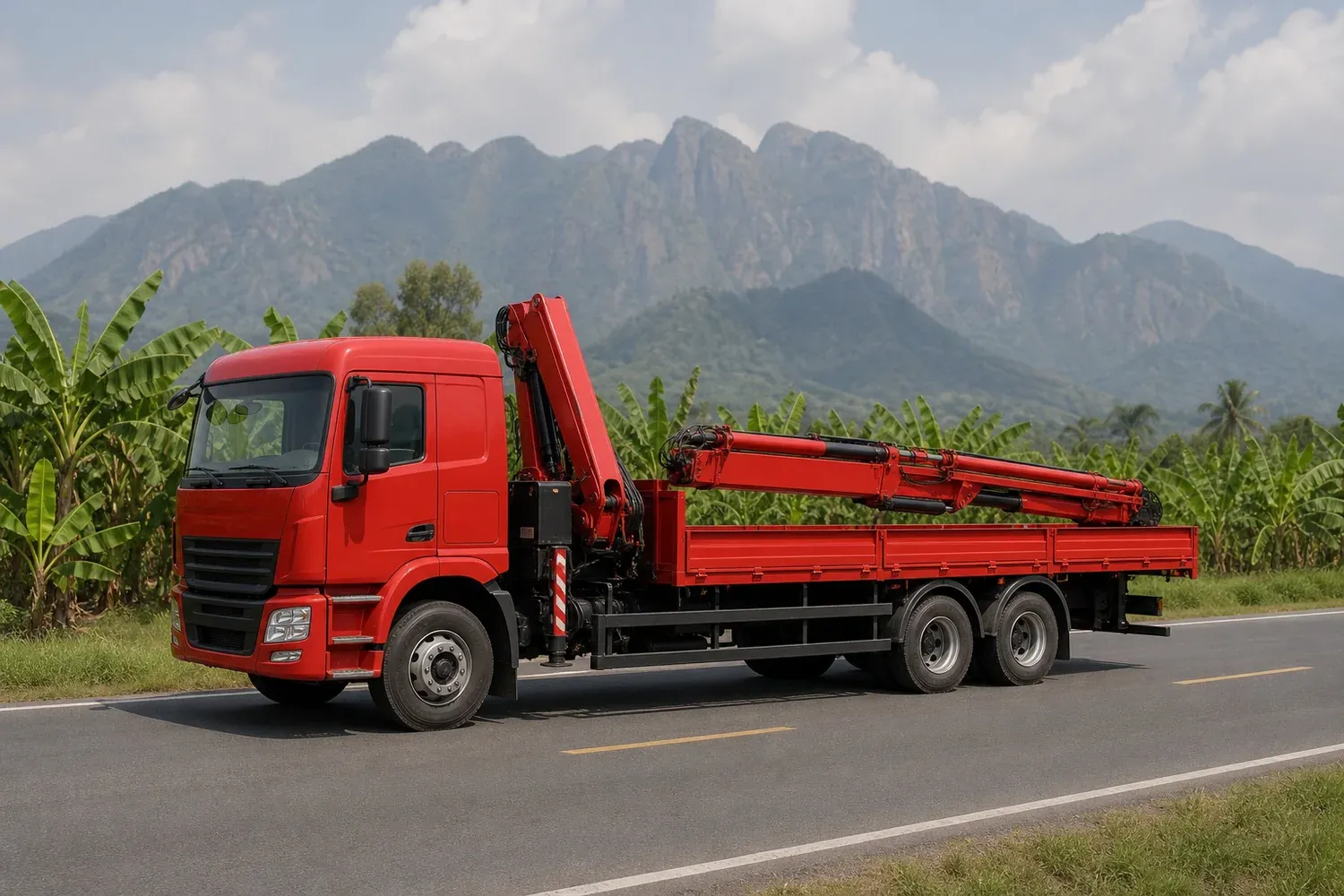
Search for how to import into Ecuador and you will find, again and again, the sentence: "Ecuador has no free trade agreement with China."
That sentence was true until 1 May 2024. The Ecuadorian government's own announcement says the agreement "entrará en vigencia el 1 de mayo de 2024" — entered into force on 1 May 2024. If your sourcing decision is being made on the strength of a guide that has not been updated since, you are pricing a tariff that may not exist in the form you think.
What the agreement does, and what it excludes
Two numbers from the official announcement matter to an equipment buyer:
- The agreement covers tariff elimination on the great majority of trade between the two countries, phased over a maximum of ten years.
- 828 product lines originating in China are excluded from the tariff reduction — the official list names textiles, apparel, school footwear, metalworking, rice, sugar and milk, among others.
So the honest position is not "tariffs are gone". It is: whether your crane truck gets a reduction depends on its tariff fraction and on whether that fraction sits in the exclusion list. Metalworking is named in the exclusions, and a truck-mounted crane sits in a machinery-adjacent classification — which is exactly why this question must be answered from the schedule, not from an article.
Ask your customs broker for the fracción arancelaria of your vehicle and the current rate for Chinese origin, with and without a valid certificate of origin. If the certificate is required for the preferential rate, the document has to be issued correctly before shipment — not after arrival.
The tax arithmetic, in the right order
Ecuador's import taxes are applied in a sequence, and getting the sequence wrong is the most common landed-cost error we see:
- Customs value built from the transaction, freight and insurance.
- Import duty on that value — rate per your tariff fraction.
- FODINFA (the child-development fund levy), reported at 0.5% of the CIF value.
- Value added tax at 15%, charged on the duty-paid value, not on the CIF value alone.
Ecuador raised IVA from 12% to 15% in 2024. A landed-cost sheet still built on 12% understates every quotation by three points of the duty-paid value — which, on a crane truck, is not a rounding error.
The 15% IVA figure and the 0.5% FODINFA figure come from trade guides rather than from our own reading of the tax code, and we label them that way. Your broker's figures govern.
The compliance stack: your broker, and possibly an inspection at origin
Ecuadorian imports clear through SENAE, the national customs service, with declarations filed through the ECUAPASS platform. Commercial imports are handled by a licensed customs broker — you cannot self-file a crane truck.
Two features of the Ecuadorian process are worth knowing before you commit to a shipping date:
- Sectoral authorisations. Depending on the product, additional agencies can be involved, and product standards can be mandatory. For machinery this is usually lighter than for food or medical goods, but it is checked before the goods arrive, not at the gate.
- Pre-shipment inspection. SENAE may require inspection at origin for certain products or values, carried out by a certifying entity before loading. If it applies to your shipment, the inspection is arranged by the importer and its cost is on the importer's side — and it changes your loading date.
Neither point is a reason to avoid Ecuador. Both are reasons to have the broker engaged before the production slot is booked.
What we could not verify, and will not pretend to
This is the part other articles leave out. We have no verified position on two questions that matter to a crane truck buyer in Ecuador:
- The emission stage currently required for new heavy vehicles at import, and the legal instrument behind it.
- The vehicle type-approval or homologación route — which authority, which documents, which sequence.
We did find two anchors worth passing on. Ecuadorian motor vehicles are subject to technical regulations (RTE INEN), of which RTE INEN 034 covers minimum safety elements, and new vehicles go through a technical review as part of the import process. Which of those applies to a crane truck, in what order, and what evidence each one demands, is the part we could not verify — so we are not going to state an answer.
What we will do is straightforward: we will build the emission package and supply the technical documentation that your Ecuadorian certification route requires, once your importer tells us what that route is. That is where the enquiry should start, and the two questions above are the first two lines to send your importer.
Where it lands
Guayaquil is the country's main Pacific gateway, with Esmeraldas to the north and Manta as the developing alternative. We quote CIF to the port you nominate; inland transport is arranged on the buyer's side.
Ecuador is a dollarised economy, which removes the currency risk that complicates comparable orders elsewhere in the region — a genuine simplification for both sides of the transaction, and one reason payment terms can be kept conventional.
What we will not tell you
- We will not quote a duty rate, and we will not claim the preferential rate applies to your shipment. Both come from the tariff fraction and a valid certificate.
- We will not state the emission stage Ecuador requires today.
- We will not describe the homologación process or its cost.
- We will not promise a sailing schedule or transit time.
- We will not assert that a China VI report is accepted as equivalent to whatever stage Ecuador requires. The certifying route decides that.
What to send us
- The tariff fraction and the rate your broker gives you, with and without preferential treatment.
- What your importer says the emission and type-approval route requires.
- Destination port and the job — tonnage, boom type, and whether the truck tips or carries only.
Left-hand drive is our standard build, and Ecuador is a left-hand-drive market, so no steering conversion is involved. Right-hand drive is available on request for other destinations. Our truck-mounted crane and grab truck listings carry the range; models and figures quoted here are those listed on this site, reviewed 1 October 2026.
Send us the tariff fraction and the port on WhatsApp and we will come back with the model, the CIF price and the documentation list your importer needs.