Oct 17, 2026
Importing a Crane Truck into Canada: The Word That Decides It Is Modify
Canada's rule is the strictest on this list and the word that decides it is modify. The three exceptions, the 15-year threshold, and where the tax actually lands.
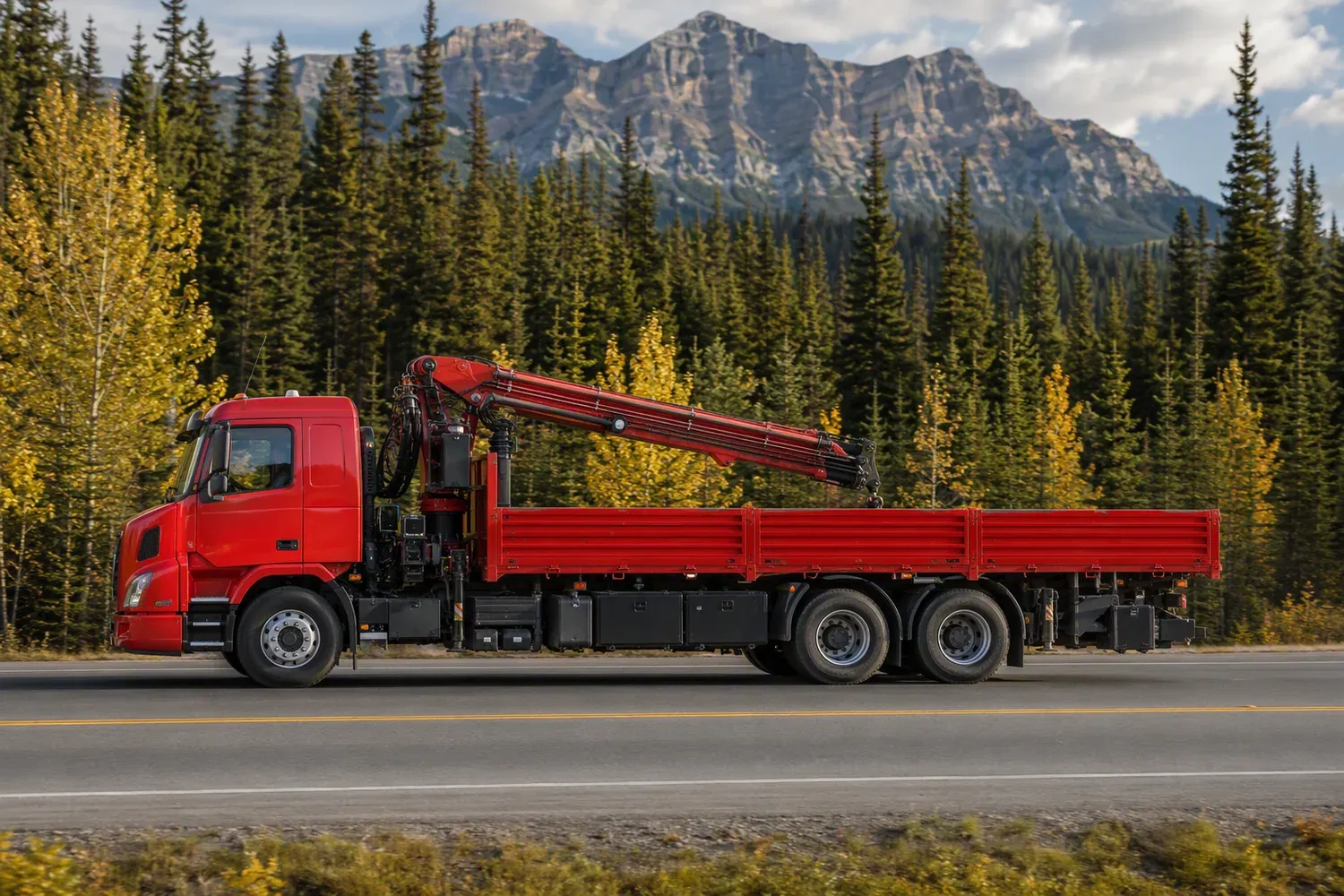
Of the markets we ship to, Canada is the one where the rule most often arrives as a surprise — and the surprise is usually a single word in a Transport Canada sentence.
That sentence is: a vehicle built and certified to meet the standards of a foreign country cannot be imported, because Canadian law does not allow such a vehicle to be modified to meet Canadian Motor Vehicle Safety Standards. Read it again with the emphasis on the verb. The obstacle is not the vehicle's quality or its age. It is that the compliance route most buyers assume — bring it in, then bring it up to standard — does not exist.
The exceptions, which are where a deal actually lives
Transport Canada's own guidance names the situations in which the prohibition does not apply. For a crane truck, three are relevant:
- The vehicle is 15 years old or older. CBSA's memorandum D19-12-1 sets the age threshold: the Motor Vehicle Safety Act import requirements apply to vehicles of regulated classes that are less than 15 years old, and RIV registration eligibility requires a vehicle less than 15 years old.
- The vehicle is not of a regulated class.
- The vehicle is brand new and purchased from the manufacturer, meeting all Canadian standards — and this route requires prior authorisation from Transport Canada before it is shipped.
Two further points from the same guidance close the loopholes around those exceptions. A vehicle modified from its original state does not qualify for import. And a vehicle built and assembled by more than one manufacturer — the guidance gives vocational truck as an example, which is what a chassis-plus-body crane truck is — carries additional requirements in its own right.
We are not going to soften any of that. If you are importing a new Chinese-built crane truck into Canada, the practical path runs through advance authorisation and a build that satisfies the Canadian standards, not through a conversion afterwards. A supplier who tells you otherwise is describing a route the importer will not have.
The entry process, once the vehicle is eligible
Declarations are made to the Canada Border Services Agency, which administers the import side on Transport Canada's behalf, using Transport Canada's Vehicle Import Form – Form 1, or the RIV e-Form 1 where the vehicle is registered in the Registrar of Imported Vehicles programme. Vehicles entering as disassembled parts use Form 3 or its electronic equivalent; there is also an electronic release route through the Integrated Import Declaration.
Vehicles in the RIV programme must then be inspected once, at an RIV-authorised inspection centre, within 45 days of arrival (one year for salvage vehicles). Only after the vehicle passes can a province or territory register it. A vehicle that fails must be exported.
Duty, and the tax layer that is usually bigger
At the time of writing, the CBSA Customs Tariff for 2026 records:
Tariff item | Article | MFN rate |
|---|---|---|
8705.10.90.00 | Crane lorries, other than railway maintenance cranes | Free |
8705.10.10.00 | Railway maintenance cranes | 6.1% |
8704.21.90.00 | Compression-ignition goods vehicles, GVW not exceeding 5 t, other | 6.1% |
Note what is absent: Canada does not apply the 25% duty that the United States applies to certain goods-vehicle subheadings. On the crane lorry line itself, the duty is free.
The tax layer is where the arithmetic happens. Federal GST is 5%. Provinces apply either a harmonised rate — Ontario 13%, New Brunswick, Newfoundland and Labrador, and Prince Edward Island 15%, Nova Scotia 14% — or a separate provincial sales tax — British Columbia 7%, Manitoba 7%, Quebec 9.975%, Saskatchewan 6% — with Alberta and the three territories at zero. CBSA's memorandum sets out when each is payable: duty, excise tax and GST are assessed at import, with the GST and the provincial component collected at registration in Nova Scotia, New Brunswick, Newfoundland and Labrador, Ontario and British Columbia, and provincial sales tax possibly collected at registration elsewhere.
Two excise items are often raised and, for this vehicle, are usually not applicable. A CAD $100 excise tax applies to imported vehicles with an air-conditioning system. The Green Levy applies only to vehicles designed primarily to carry passengers, and CBSA's memorandum expressly excludes pickups, vans with ten or more seats, ambulances and hearses from it. The luxury tax applies to "subject vehicles" over CAD $100,000 — again defined around vehicles designed primarily to carry passengers, with ten or fewer seats and a GVWR of 3,856 kg or less — which a crane truck is not.
One tariff note that has been circulating: since 8 September 2026, Canada has applied counter-surtaxes to certain goods imported from the United States. That is a US-origin measure. It is not a China-origin measure, and we are not aware of an official list applying an equivalent to this heading — a point we flag as unverified rather than answered.
What we could not verify, and will not pretend to
- The tariff rate for 8426.49, if your build is classed as self-propelled machinery rather than a crane lorry.
- The formal name and instrument number of Canada's off-road compression-ignition engine emission regulations. We confirmed the framework sits with Environment and Climate Change Canada under the Canadian Environmental Protection Act, and CBSA's memorandum lists the on-road vehicle instruments — but the specific instrument for off-road compression-ignition engines we could not retrieve.
- Whether a crane lorry is judged on-road or off-road for emissions purposes in Canada. We did not find a Canadian provision that settles it.
- Whether any surtax applies to Chinese-origin 8705.10.
- Any federal-level equivalent of the United States' construction crane rules — Canadian occupational health and safety is primarily provincial, and we did not retrieve a federal provision for crane operation or operator certification.
What we will not tell you
- We will not say a new Chinese-built crane truck can simply be imported. The route exists only through the exceptions above, and one of them requires authorisation before shipment.
- We will not obtain Transport Canada authorisation for you. We supply build documentation; the authorisation is the importer's to hold.
- We will not quote a provincial tax total. It depends on the province of registration, and the rate table above is the input, not the answer.
- We will not describe a conversion programme. If a supplier is proposing to bring the truck in and then make it compliant, that is the route the law closes.
What to send us
- Which exception you are importing under, and whether Transport Canada authorisation is already in hand.
- The province of registration, so the tax layer can be estimated properly.
- The job: tonnage, boom type, body type, and whether the crane is used in construction.
- Whether the truck will be new or used at the time of import.
Our quoted models and figures are those listed on this site, reviewed 1 October 2026. The truck-mounted crane and grab truck listings carry the range; the neighbouring market's route is described in the United States guide, and the emission-label question in general is covered separately.
Left-hand drive is our standard build; right-hand drive is available on request for other destinations. Canada is left-hand-drive, so no steering conversion is involved.
Send us the four lines on WhatsApp and we will come back with the build documentation your importer needs for the authorisation route.