Sep 30, 2026
When a Grab Truck Actually Needs 4x4 — and What You Give Up to Get It
4x4 is usually specified too late and too casually. Where it genuinely earns its cost, where it does not, and what you give up in payload, deck length and cost to get it.
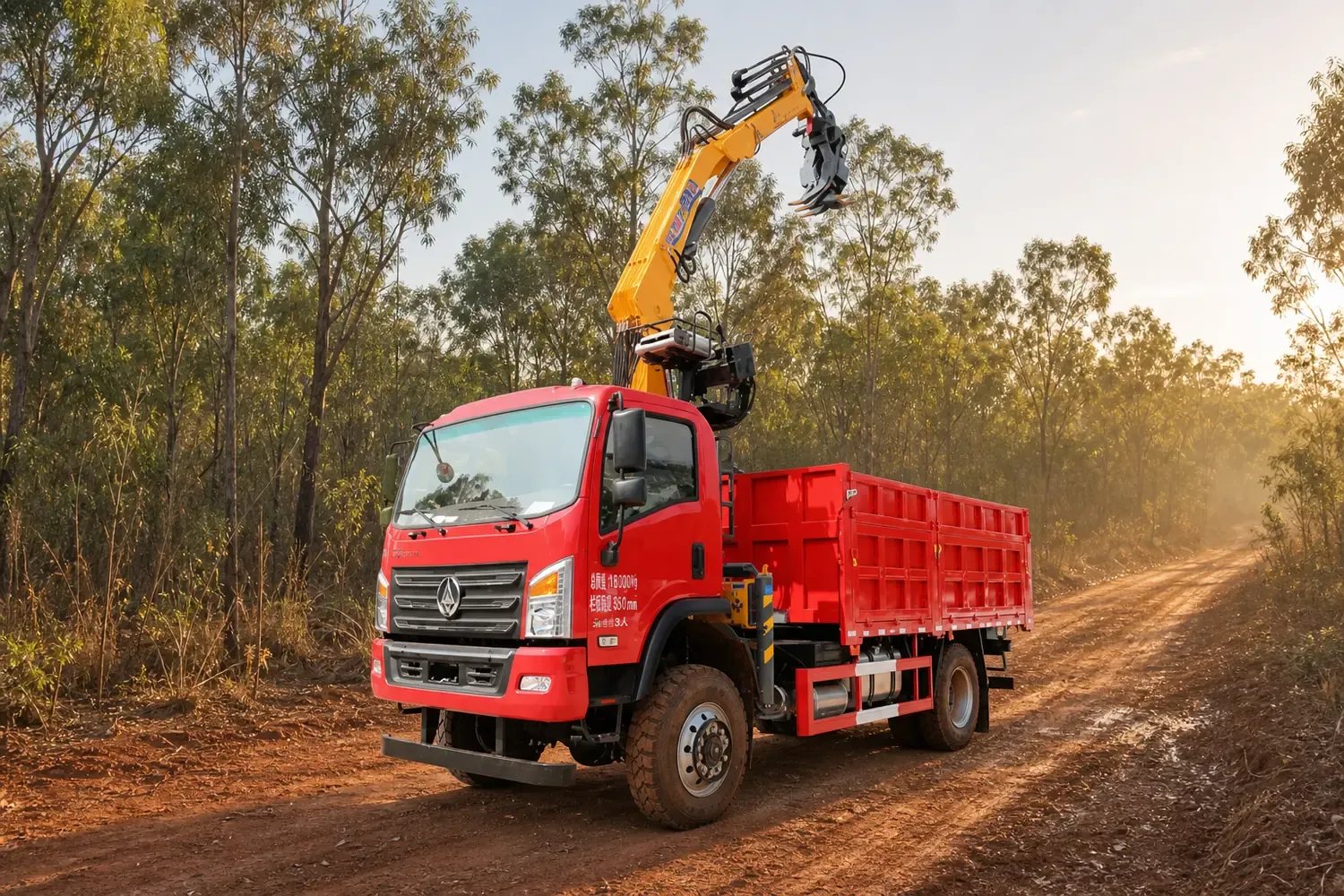
4x4 is the option buyers ask for too late and specify too casually.
Too late, because it is a chassis decision — it cannot be added to a truck after it is built. Too casually, because "we might need it" is not a specification, and the cost of 4x4 is not only money. It is wheelbase, body length, and payload.
Here is the test we use with buyers, and the arithmetic behind it.
The test: three questions, in order
1. Does the truck ever leave a surfaced road while loaded?
This is the question that actually decides it. A grab truck that is loaded on a hard road and driven to a paved yard is a two-wheel-drive machine regardless of what the site around it looks like. A grab truck that must climb out of a forest track with a full load is a different machine.
The word that matters is loaded. An empty truck climbs terrain that the same truck will not climb fully loaded, and buyers routinely reason from the empty case.
2. Is the surface unsurfaced — and does it change with the season?
Laterite, red earth and unpaved haul roads behave very differently dry and wet. If the answer to "is there a rainy season" is yes, and the truck must keep working through it, that is a traction requirement, not a comfort requirement.
3. Does the truck have to start on the grade, or only pass it?
Starting a loaded machine on a loose climb is a harder demand than driving one across a gentle slope. If your work involves loading mid-slope — common on timber operations — say so explicitly.
What 4x4 gives you, mechanically
Our four-wheel-drive grab builds are part-time systems with selectable engagement: the front axle is driven when you engage it, not permanently. That is the right architecture for a work truck, because a permanently driven front axle costs fuel and tyre wear on every paved kilometre the truck ever runs.
Two things follow, and both are practical:
- Traction is a decision the operator makes. A part-time system only helps if the driver engages it before the truck is stuck, not after.
- The driveline is another set of components. A transfer case, a front propeller shaft and a driven front axle are all additional things that can fail, and all additional places that need a workshop that understands them.
What you give up
This is the part that rarely appears in a quotation, and it is the reason we push back on 4x4 requests.
Wheelbase. A four-wheel-drive grab in our range is built on a single-cab chassis. The cab and the driveline constrain the wheelbase, and wheelbase constrains body length. If your job needs a long body, 4x4 and body length are competing for the same millimetres.
Payload against axle rating. A driven front axle is heavier and is rated for its own load. That weight comes out of what the machine can carry in the same permitted gross weight.
Ride and turning. A driven front axle on an unsurfaced road is harsher, and the steering lock is usually tighter. If the truck also does a lot of paved work, you are paying for capability you are not using.
Sometimes 4x4 is the wrong answer
If your problem is soft ground rather than a steep grade, traction may not be what is failing you. A 6x4 chassis with a lifting axle keeps the drive wheels loaded by lifting an unloaded axle out of the surface — a configuration we build, and one that often solves a soft-yard problem that a 4x4 truck would also solve, at a different cost in payload and body length.
Your actual problem | Does 4x4 solve it? | Consider instead |
|---|---|---|
Loaded climb on a loose or wet track | Yes — this is the case it exists for | — |
Soft, muddy yard or transfer station | Partly | 6x4 with lifting axle |
Long body needed, occasional rough track | No — the wheelbase cost is worse than the benefit | 6x4 with good tyres, and accept slower transit |
Uneven ground where the body would twist | No | Chassis and mounting design, not drive configuration |
Truck must also move material to the other side of an obstacle | No | Boom reach, not traction |
What we will not tell you
- Gradients and angles. We will not print a climbable percentage or an approach angle for any model. Those figures depend on load, surface and tyre, and a number on a page gets quoted back to us on a site it does not describe.
- Fuel consumption. A part-time system costs nothing extra when disengaged and some amount extra when engaged, on a site we have not seen. Any single figure would be a fabrication.
- A price difference between 4x4 and 6x4. Different chassis, different body, different total. Ask, and you get a quotation for a configuration, not a delta.
- That 4x4 can be added later. It cannot. This is the one claim on this page we want you to treat as absolute.
How to brief a 4x4 requirement
Tell us, in this order:
- The worst climb the truck must make with a full load — surface, and roughly how long the climb is.
- Whether it must work through the wet season.
- How long a body you need — because that is what 4x4 is competing with.
- Your market's steering side and fuel sulphur — the second of those decides the engine, and on a 4x4 build it decides it before the driveline is chosen.
We build left-hand and right-hand drive, mechanically controlled and electronically controlled, on more than one chassis family. Which combination is right is decided by your market, not by the price list.
Working out whether your terrain needs 4x4? Send us a photo of the worst road the truck will see when loaded. That is a faster answer than a specification.
Rules, standards and fuel specifications change. Verify with your local importer and registration authority before you order. This page describes how we build and what we will and will not commit to; it is not a statement of your market's legal requirements.