Sep 15, 2026
How to Read a Load Chart Before You Choose a Crane
A crane rated at 8 t does not lift 8 t at full reach. How to read a load chart, and the three mistakes buyers make when specifying lifting capacity.
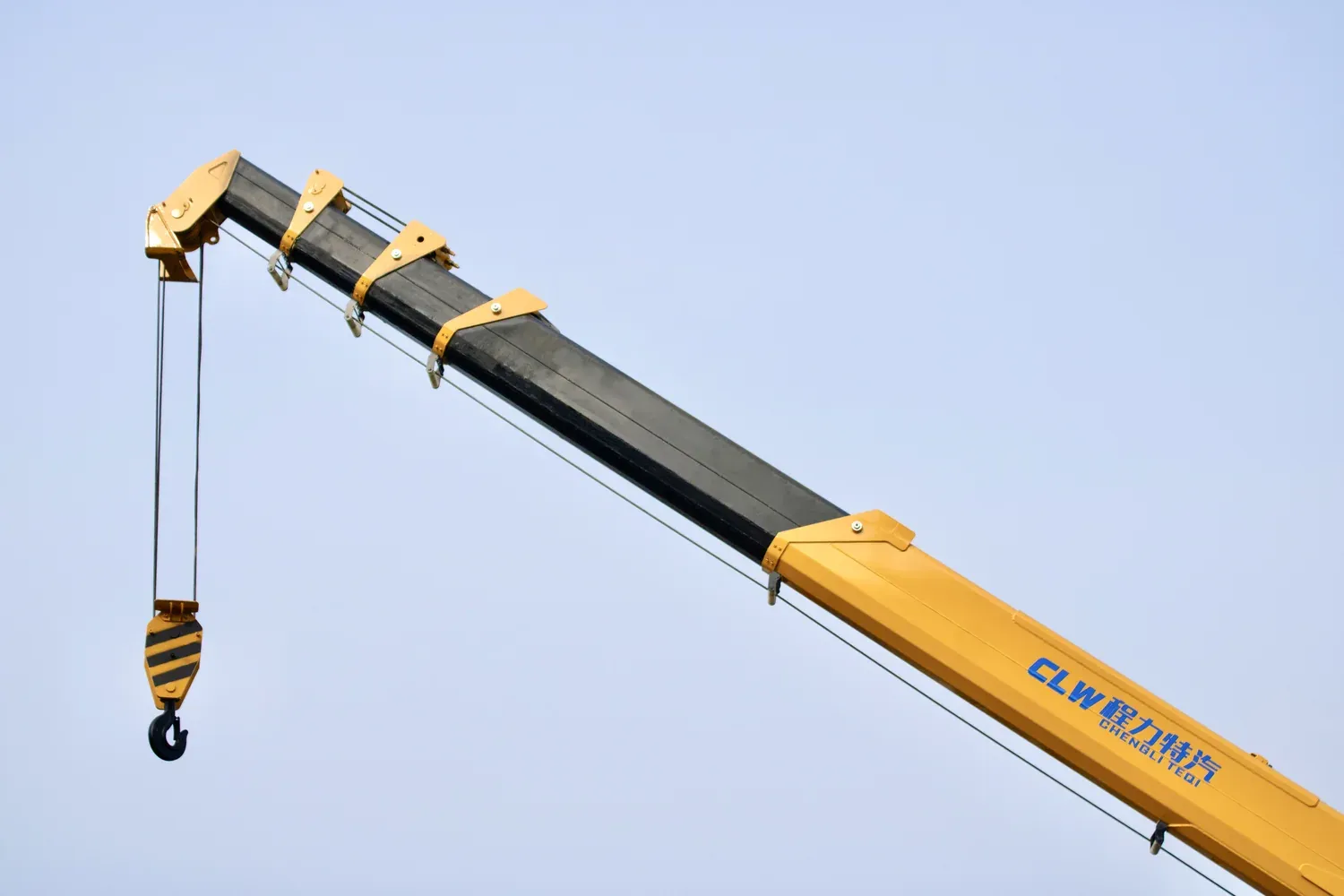
A truck-mounted crane advertised as "8 ton" will not lift eight tonnes at the end of its boom. Not close. On one of our 8 t models, the rated capacity at 17.6 m of working radius is 500 kg — about one sixteenth of the headline number.
That is not a defect. It is how every crane in the world works. And it is the single most common source of a bad buying decision.
The headline number is a maximum, not a capability
"8 ton" means: at the shortest working radius, with the boom fully retracted and the outriggers fully extended, this crane lifts 8 tonnes. Move the load further out and capacity falls — fast, and not in a straight line.
A buyer who specifies a crane by the headline number alone will discover the problem on site, after the machine has been paid for and shipped.
What a load chart actually tells you
A load chart is a two-row table. The first row is working radius — the horizontal distance from the crane's centre of rotation to the hook. The second row is rated capacity — the maximum load at that radius.
Here is a real chart from our SQS200-5, an 8 t five-section crane:
Working radius (m) | 2.5 | 4.0 | 6.0 | 8.0 | 10.0 | 12.0 | 14.0 | 17.6 |
Rated capacity (kg) | 8000 | 3600 | 3000 | 2100 | 1900 | 1400 | 1100 | 500 |
Read it as a shape, not a number. Between 2.5 m and 4 m — one and a half metres of extra reach — capacity falls by more than half. From 14 m to 17.6 m it falls again, from 1,100 kg to 500 kg.
Three mistakes buyers make
1. Specifying by tonnage instead of by radius.
The right question is not "how many tonnes is this crane?" It is "at what radius do I need to lift what weight?" A site that needs 3 tonnes at 12 m is not served by an 8 t crane that lifts 1,400 kg there. It needs a bigger model — or a different lifting method.
2. Forgetting that outriggers are part of the rating.
Published capacities assume the outriggers are fully extended. On a narrow site — a yard with adjacent buildings, a road with traffic on both sides — you may not be able to extend them fully. Capacity drops. Plan for the site you actually have, not the test pad.
3. Confusing boom length with working radius.
Boom length is the structural length of the boom. Working radius is measured horizontally from the centre of rotation to the hook, and it changes as the boom is raised or lowered. Maximum boom length does not mean maximum radius in every configuration — and maximum radius is usually achieved with the boom near horizontal, where capacity is lowest.
The question to ask before you buy
Write this down and send it to whoever is quoting you:
I need to lift ______ kg, at a working radius of ______ m, with the outriggers ______ (fully / partially) extended.
Three blanks. Every competent supplier can answer that. A supplier who cannot is quoting you a catalogue, not a crane.
What to send us
If you have the three blanks, send them. If you have a job description instead — "we unload steel bundles from a truck bed" — send that, and tell us the bundle weight and how far the crane has to reach. We will come back with a specific model and the load chart section that covers your job.
Load testing. Every unit we ship is load-tested at the factory before dispatch. Ask any supplier the same question — and ask how they test, not just whether they do.
Need a load chart for a specific model? Message us on WhatsApp at +86 158 0912 4321 and tell us the model.