Oct 22, 2026
Why Your Truck Mounted Crane Lifts Slowly — and What to Check First
Slow lifting is usually flow, not a worn pump. The four cheap checks in order, what not to adjust, and how to tell a tired pump from a drive fault.
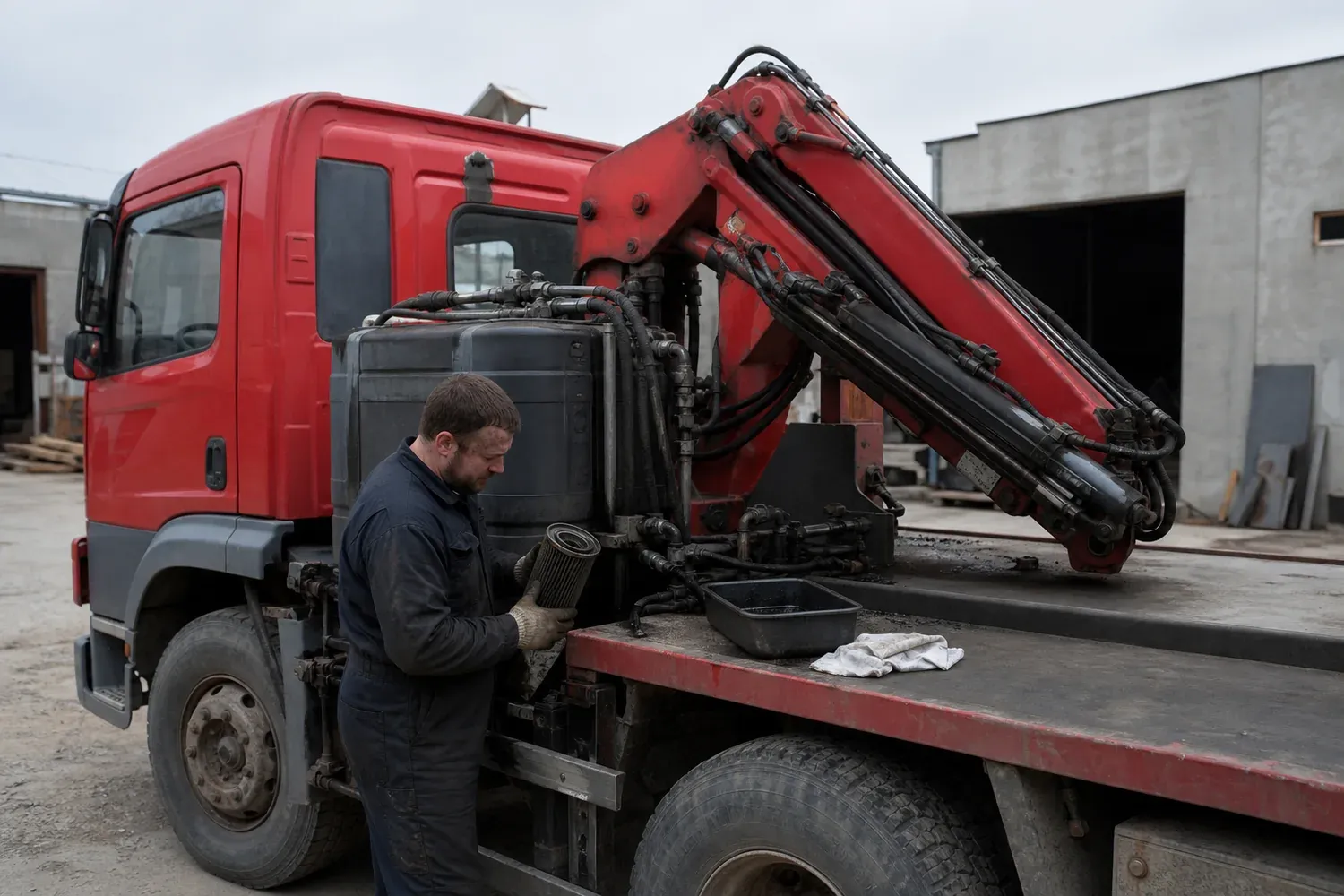
A crane that lifts slowly is not automatically a worn crane. In most cases we are asked about, the pump is fine and something much cheaper is wrong: a filter, a suction line, or oil that should have been changed a season ago.
The order of checks matters more than the tools you own. Start with the pump and you will spend money; start with the filter and you will often save it. Here is the sequence we walk through, in order, whenever a customer reports truck mounted crane slow lifting.
Separate "slow" from "weak"
Slow means the boom moves sluggishly but still takes the load. Weak means it stalls, holds back, or refuses to lift a load it used to take without complaint.
The distinction decides where you look. Slowness usually points at flow: a restriction, a filter, a tired pump, or oil too thick to move on a cold morning. Weakness usually points at pressure or at something mechanical, such as a relief valve opening early or a boom section binding.
Write down which one you actually have before touching anything. Operators often report "weak" when the real complaint is that a job now takes four minutes instead of two, and those two problems lead to completely different money.
The four cheap causes, in order
Start with oil level, checked with the boom stowed and the cylinders retracted, because a low reservoir starves the pump long before it fails. Then look at the oil itself: dark, gritty or milky oil is a finding on its own.
Next, the suction side. A perished suction hose, a loose clamp or a partly blocked strainer lets the pump cavitate, and cavitation looks exactly like a weak pump from the operator's seat. It also sounds like gravel moving through the line, which is the cheapest diagnosis you will ever get.
Then the return filter. A clogged element raises back pressure, opens the bypass and sends dirt straight back into the system. If the filter has not been changed since the last owner, change it before forming any opinion about the pump.
What not to do before you have measured
Do not raise the relief valve to "get the speed back". If it was set correctly when the crane was built, raising it converts a filter problem into a pump and valve problem. It can also overload the boom, the pins and the mounting on the next heavy lift.
Do not top up with a thicker oil to hide a leak or a noise. Wrong viscosity changes flow and heat, and it makes the next diagnosis harder for whoever inherits the truck and its paperwork.
Do not run the crane at full extension to "test" it after a repair. Test at the radius you work at, with the outriggers set the way you set them on site, and compare that against a note you made before the repair started.
When it really is the pump
A pump is the answer when flow is low at normal temperature, the suction side is clean, the filter is new and the oil is correct. At that point a flow and pressure test tells you whether it is wear or a setting, and the two have very different price tags.
Wear usually arrives gradually and shows up as heat plus noise plus slow movement together. A sudden failure is more often a drive problem, such as a stripped coupling, a sheared key or a power take-off that is not fully engaged, and that is worth checking before ordering parts.
If the crane is old enough that the pump is genuinely tired, compare the cost of a pump against the cost of the unit's downtime. On a truck that lifts all day, a rebuilt pump is usually cheaper than a week of lost work, but the decision should be made with test results in front of you rather than with a guess.
What to do next
If you are specifying new trucks and want fewer of these problems in year two, tell us the duty cycle, the climate and who will service the crane. We will match the crane and the chassis to that reality, and tell you which spare filters and hoses are worth keeping on the shelf.
If a truck is already slow, send us a short video of the lift with the engine at working speed and the oil at temperature. Nine times out of ten the sound alone narrows it down, and it saves you a service visit before you spend anything.
Ask for the crane manual with the truck, not after the first fault. A manual that lists the filter numbers and the suction layout turns this article into a fifteen minute job for your own mechanic instead of a week of waiting for advice from another time zone. Add one line to your service sheet for lifting speed at a fixed radius, and the next slow crane will be measured against a number rather than a memory.
Related reading: our notes on hydraulic oil and the first winter, reading a load chart before you choose a crane, and what a factory acceptance visit should cover. The current truck mounted crane range is listed on the products page.