Oct 4, 2026
Scrap Grabber or Magnet: What to Fit on a Scrap Truck
Scrap is not one material. When a grab beats a magnet, when a magnet beats a grab, and the units that carry both, with the models we build side by side.
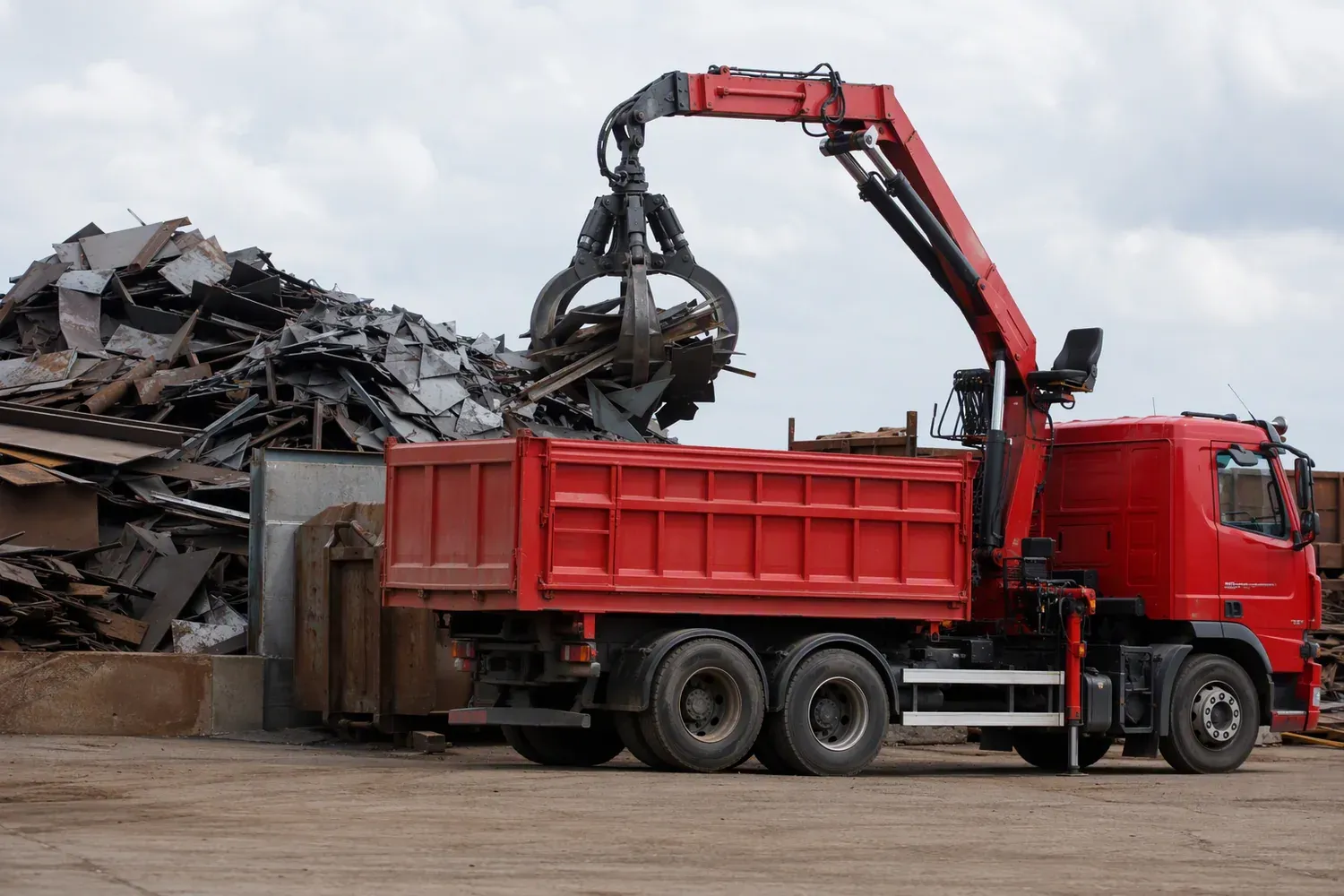
The scrap truck is not specified by tonnage. It is specified by what the material does when you try to pick it up.
Two loads of the same weight behave completely differently: baled plate sits still and can be gripped, while tangled wire and mixed turnings fall straight out of a grab. Choose the wrong end effector and the truck is not slow — it is unusable on half of your intake.
The rule that decides it
If the material is | Fit | Why |
|---|---|---|
Mixed, bulky, tangled, or partly non-ferrous | Grab (3+2 twin-ram, with bucket teeth for offcuts) | It holds the load through the whole cycle, whatever the shape |
Clean ferrous, high volume, small pieces | Magnet (self-powered electromagnetic chuck) | It picks what a grab drops, and it drops it on command |
Long or oversize scrap | Grab with an on-board cutter | The material has to be cut before it can be lifted |
Material that changes by the week | Grab with a quick-coupler, magnet as the second head | The head is the interchangeable part, not the truck |
The mistake to avoid is treating "scrap" as one material. A yard that buys from demolition sites and a yard that buys turnings from a machine shop need different ends of this table.
What we actually build
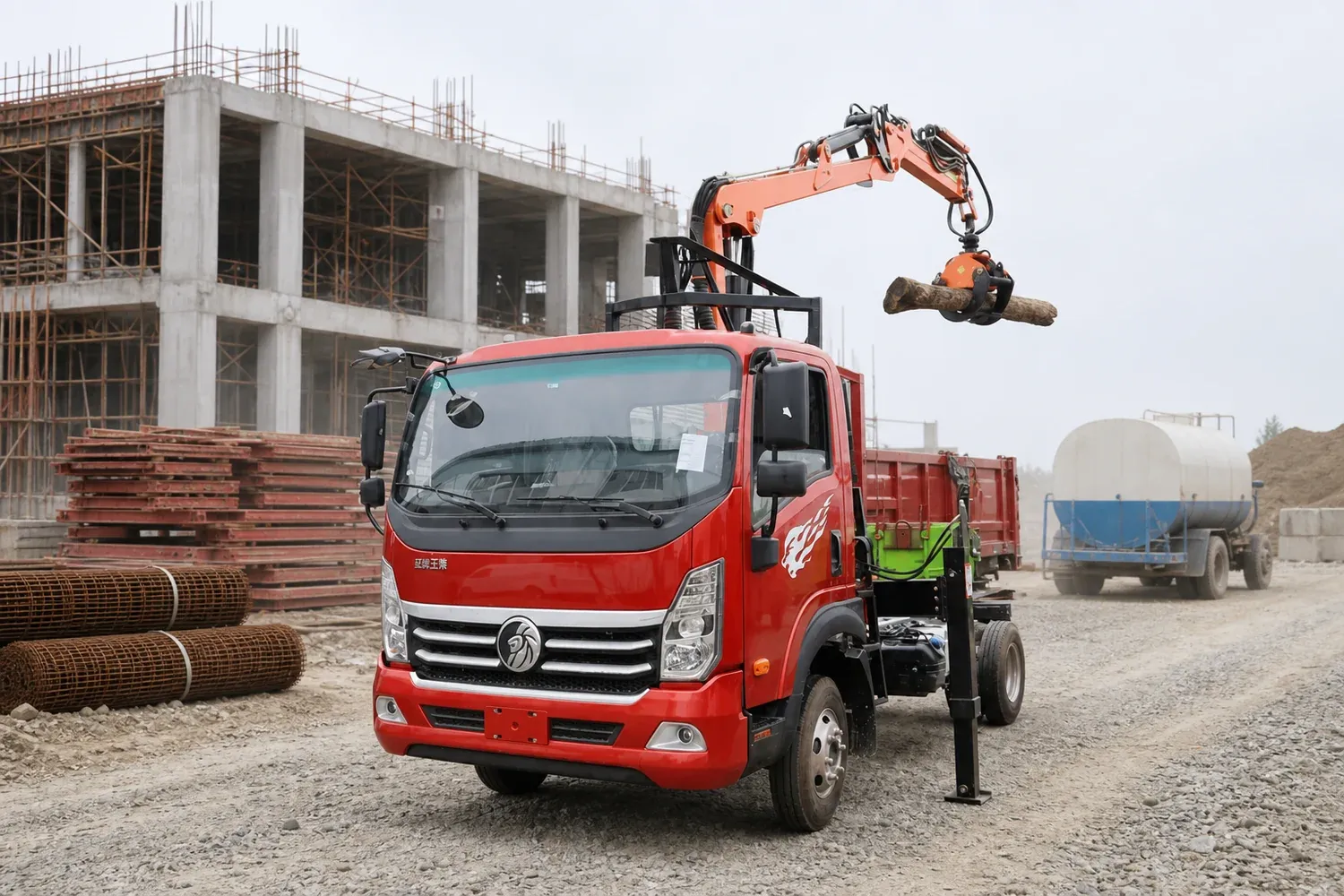
Every unit below is a knuckle-boom crane with a scrap head on the end of it. The differences are the head, the chassis class and the body.
Model | Chassis | Crane / boom | Head |
|---|---|---|---|
TMG-DY2501 | Dayun, lifting axle, 24,500 kg GVW | 8 t, 4-section knuckle boom | 3+2 twin-ram grab with bucket teeth; quick-coupler and through sub-frame fitted |
TMG-DY2502 | Dayun, lifting axle, 24,500 kg GVW | 8 t, 4-section knuckle boom | Magnet and on-board cutter, plus 3+2 twin-ram grab with bucket teeth |
TMG-SX2501 | SHACMAN Delong L5000 | 8 t, 4-section, 9.7 m boom, 12.7 m working height | 3+2 steel grab |
TMG-WP2510 | SINOTRUK Wangpai | 6.3 t, 3-section, supplied with a lifting hook | 3+2 twin-ram grab for steel offcuts |
TMG-DF2506 | Dongfeng D3S 6x4 | 8 t, 4-section knuckle boom | Self-powered electromagnetic chuck plus 3+2 scrap grab |
TMG-DF2507 | Dongfeng Huashen DV3, 18,000 kg GVW | 6.3 t, 3-section, 8.25 m radius | Self-powered high-frequency electromagnetic chuck plus 3+2 universal grab |
TMG-FW2502 | FAW J6L | 8 t, 4-section knuckle boom | 900 mm electromagnetic chuck plus 3+2 scrap grab |
TMG-Y27 | SINOTRUK Wangpai extended cab, 3,900 mm wheelbase | 6.3 t, 3-section full-slewing | 3+2 twin-ram scrap grab |
Three details in that table are worth reading twice.
The magnets are self-powered, high-frequency chucks. They carry their own power source on the truck, which is what makes a magnet unit practical on a scrapyard of any size rather than only where a dedicated magnet crane already exists.
Two units combine heads. TMG-DY2502 carries a magnet and a cutter; TMG-DY2501 and the magnet units also carry a grab. That is not indecision — it is the recognition that a scrap yard's intake is never one material.
Bucket teeth are a specification, not a detail. The 3+2 twin-ram grabs with bucket teeth on the Dayun units are the ones to look at for steel offcuts and irregular plate; the general 3+2 steel grab on the SHACMAN unit is the all-round head.
Grab-only, magnet, or both: the comparison that decides
One comparison matters more than the rest. A grab unit is limited by its boom and its body; a magnet unit adds a power source, its own duty cycle and a second electrical system to maintain. That is the trade you are actually making.
Question | Points to |
|---|---|
Is most of your intake ferrous, sorted and small? | Magnet, and a grab as the second head |
Is it mixed, tangled, or bought by the load? | Grab first; the magnet will not pick non-ferrous |
Do you handle long stock that must be cut to load? | Cutter (see TMG-DY2502) |
Does the truck work from a yard with a fixed machine already? | A grab truck that can also road-haul — not a second magnet |
Grab units in this range run on 6x2, 6x4 and 8x4 chassis with tipping bodies — TMG-DY2501 and TMG-DY2502 tip forward on a 7,000 × 2,400 × 1,500 mm body, while TMG-WP2510 carries a smaller 3,100 × 2,200 × 600 mm body in 3 mm side and 5 mm floor steel. Body size follows your material volume, not the crane.
What we will not tell you
- We do not publish the magnet's lifting capacity. A chuck is rated on the material it is placed on, and we will not quote a figure that changes with the load.
- We do not state a grab's gripping force or jaw opening, except where it is published for a specific timber head on this site.
- We will not say a magnet will handle mixed scrap. A magnet attracts ferrous metal. It does not pick stainless, aluminium, rubber or tangled non-ferrous.
- We will not say one head covers every yard. If your intake changes seasonally, the answer is a quick-coupler and two heads, not a bigger crane.
What to send us
Tell us the material mix in rough percentages, the piece sizes, how the material arrives (loose, baled, on pallets), and whether the truck must also haul on the road or works inside a yard only. Those four answers pick the head, the crane class and the body together.
Left-hand drive is our standard build; right-hand drive is available on request. All models, crane ratings and body dimensions on this page are those currently listed on this site, reviewed 1 October 2026.
Send us the material mix on WhatsApp and we will tell you which head to fit — and whether you need the magnet at all.