Choose the Aerial Platform by the Job, Not by the Highest Number on the Sheet
Six kinds of work, six height brackets, and the chassis questions that decide road access. Why a bigger machine can cost more per job.
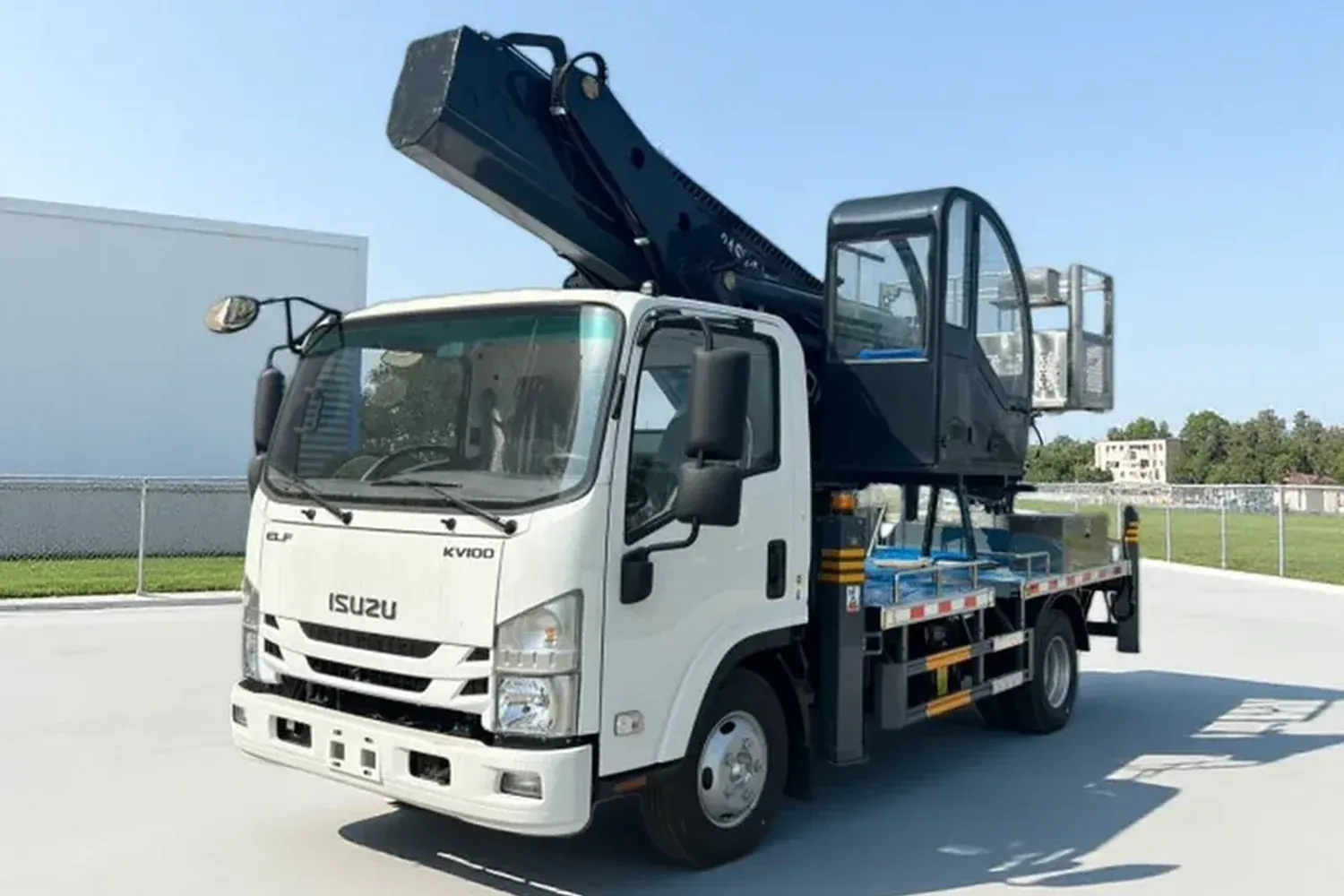
A fleet that buys 45 m machines "so we are covered" ends up sending a 45 m truck to change a lamp at 9 m, on a street it can barely set up in. The height was never the constraint. The job was.
This is how we would narrow the range for the six kinds of work that actually buy vehicle-mounted platforms, in the order the decision usually runs.
1. Street lighting and sign maintenance — usually 13 m to 18 m
Poles are worked on from one side, at a known height, from a vehicle parked on the road. The requirement is fast setup, low overall height for travelling under trees and wires, and a basket big enough for one technician and a toolbox.
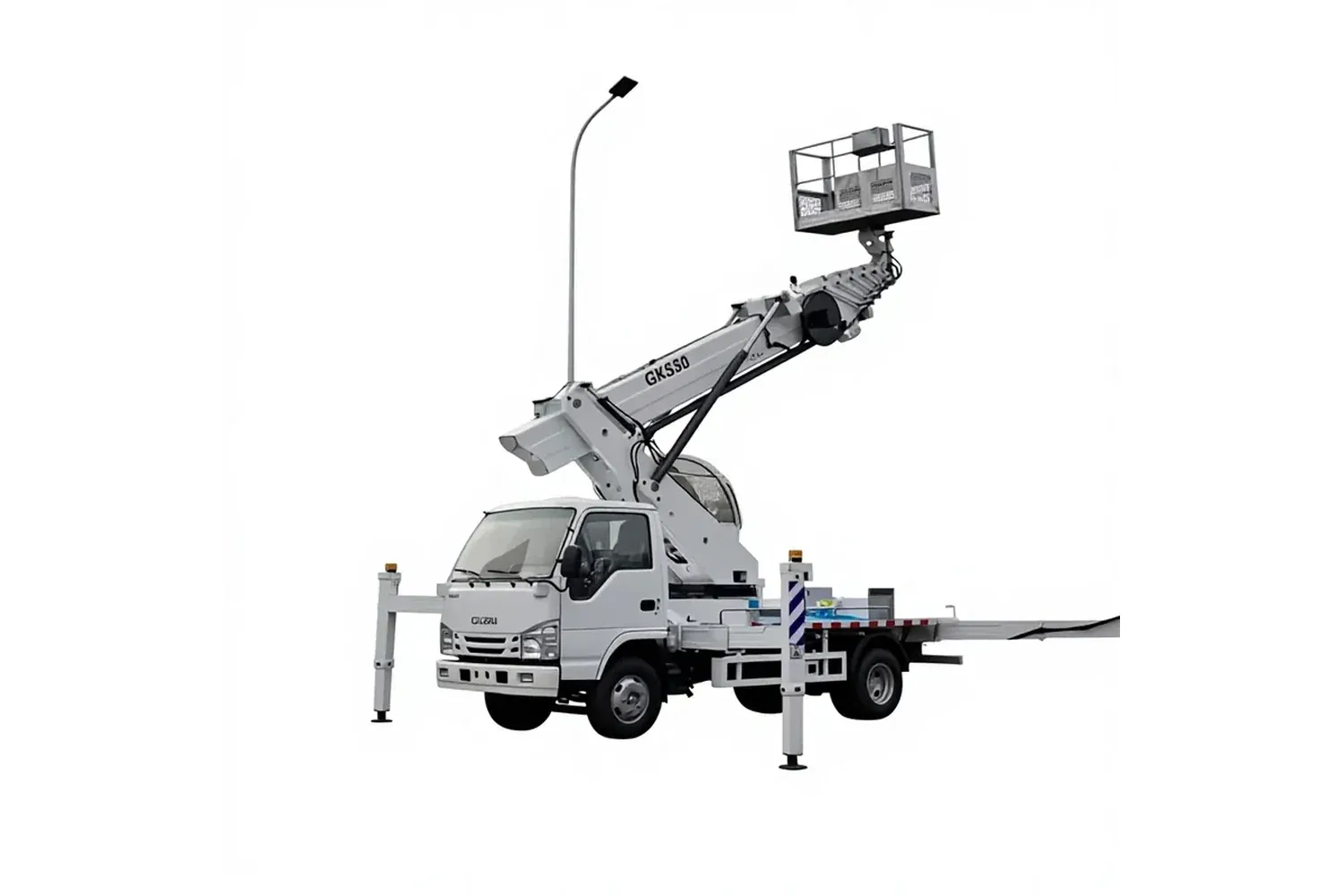
Our 13 m and 15 m units are built for this: short chassis, 200 kg basket, V-form outriggers that can be tucked around kerbs and parked cars. A 25 m unit does the same job while needing more road, more setup and more fuel.
Deciding question: how many stops per shift, and what is the narrowest road on the route?
2. Municipal maintenance and tree work — 15 m to 22 m
Branches and street furniture are not directly above the vehicle and not neatly aligned. This is where articulated booms earn their price: the knuckle lets the basket go up, over and back down into a canopy or over a fence, without repositioning the truck.
A telescopic boom is faster in a straight line and simpler to operate. It is the wrong tool when the work point is behind an obstruction at height.
Deciding question: is the work point directly reachable from the parking position, or is something in the way?
3. Facade, glazing and cladding — 20 m to 30 m
Here outreach matters more than height. A facade is a vertical plane, and the basket has to sit alongside it, not above the truck. That means evaluating the working height at the outreach you need, not at zero outreach.
Our 30 m telescopic unit reaches 14 m sideways, but the working height at that outreach is 5 m. If your facade is 25 m up and 8 m from the kerb, that machine is not the answer; you need to look at the height/outreach pair as a curve, not as a single figure.
Deciding question: what is the horizontal distance from a legal parking position to the work face?
4. Construction and steel erection — 28 m to 45 m
High reach, longer duration on one site, and a crew that needs the basket rated for two people plus material. Setup time matters less because the machine stays put. Transport and site access matter more, because the unit is long and heavy.
Our 28 m, 32 m, 33 m and 45 m units sit in this bracket, mostly on Isuzu and SHACMAN chassis. Basket ratings vary by model — 45 m is offered with 100 kg, 200 kg or 250 kg baskets, and the choice changes what you can legally lift.
Deciding question: how many people and how much material must the basket carry at height?
5. Telecom and CCTV — 18 m to 28 m
Mast work needs the basket alongside a pole or a wall, often in a compound with limited space, and often with power nearby. Reach and precise positioning matter; maximum height usually does not.
Deciding question: can the vehicle get inside the compound, or does everything happen from the street?
6. Whatever the answer is, the chassis decides the rest
Two units with the same height can behave completely differently because of the chassis underneath. Wheelbase decides the turning circle in old town streets; gross weight decides what licence and what bridge the unit can use; the cab decides whether the crew travels in comfort for a two-hour drive to site.
Our 30 m unit, for example, sits on a JMC Shunwei chassis with a 2,800 mm wheelbase, 4,495 kg gross weight and a 5,998 mm overall length — compact for its height, which is why it works in city centres. A 45 m unit on a heavier chassis will not.
Deciding question: what does the vehicle have to do when it is not lifting?
When a bigger machine is the wrong purchase
- If more than half your jobs are under 18 m, the larger unit costs you road access, setup time and fuel on every one of them.
- If the streets are narrow, the outrigger spread, not the height, will stop you. See outrigger spread and ground bearing.
- If you need indoor work, no truck-mounted platform is right — exhaust and clearance rule it out.
- If you need 40 m only twice a year, hiring or subcontracting those two jobs is usually cheaper than owning the machine.
A simple way to specify
Write down the six items above as answers, not as preferences: stops per shift, narrowest road, height and outreach of the work point, basket load, chassis constraints (licence, bridges, turning), and indoor or outdoor. Send that and you will get comparable quotes instead of a catalogue.