Sep 29, 2026
Which SASO Certificate Does Your Crane Truck Need in Saudi Arabia? The Full Official List
SASO publishes a numbered list of conformity certificates. Two of its entries apply to a truck-mounted crane — one to the truck, one to the crane — and they are certified separately.
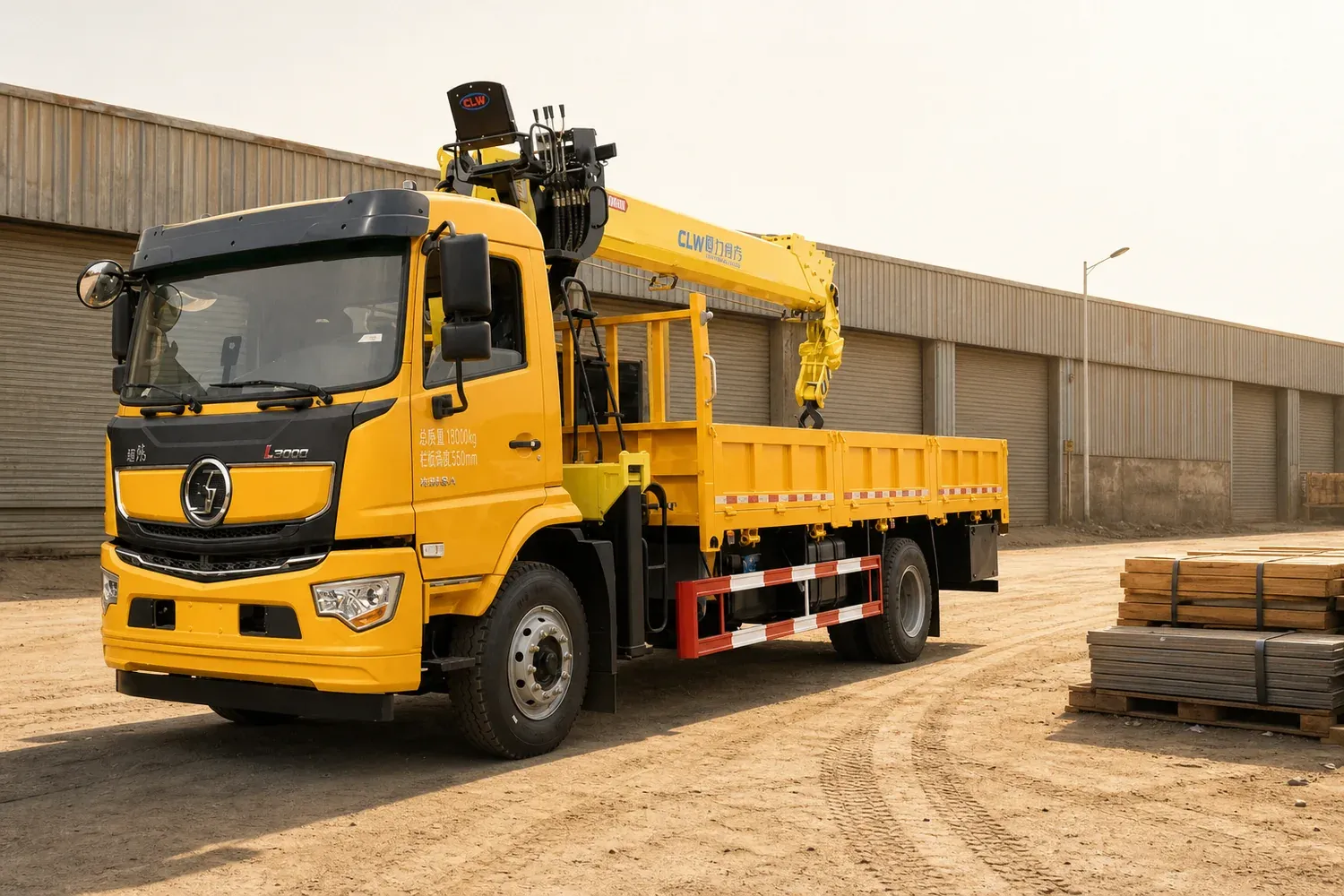
Most suppliers quoting into Saudi Arabia say "you need SABER" and stop there. SABER is the portal, not the requirement. The requirement is a set of specific certificates, and SASO publishes them as a numbered list.
That list is where crane truck imports actually get decided. Two of its entries apply to a truck-mounted crane directly — one to the truck, one to the crane — and they are certified separately, at different stages, from different starting documents.
(We have written separately about what stops a Saudi shipment on the certification and emission side. This article is the reference catalogue: the full list, the standards behind it, and how to work out which entries apply to your machine.)
First, why you cannot file any of this yourself
Saudi Arabia's conformity assessment runs through SABER, the electronic portal under the Saleem product safety programme, in two stages:
- PCoC — Product Certificate of Conformity. Model-specific, one per model.
- SCoC — Shipment Certificate of Conformity. One per shipment.
The SABER portal is open only to Saudi importers, SASO-approved certification bodies and Saudi Customs. An overseas exporter cannot open an account or file a declaration. So this list is not a to-do list for your supplier. It is a to-do list for your importer, and the supplier's job is to prepare the technical file behind it early enough to matter.
SASO also issues a Certificate of Conformity for Model Approval, confirming that a product complies with the applicable standards, for use by manufacturers, suppliers and exporters. That is the export-side document.
The list, mapped to machine types
From SASO's official Certificates of Conformity list (last modified 28 September 2025), the entries relevant to this product family:
# | Certificate (official name) | Applies to | Relevance to a crane truck |
|---|---|---|---|
7 | Certificate of Conformity for Trucks and Trailers Under-run Protective Devices | Trucks, trailers and semi-trailers over 3.5 t GVW — front, side and rear under-run protection. Excludes off-highway vehicles, military vehicles, and specialised trucks on which the device cannot be installed. | A crane truck on a commercial chassis is a truck. The protection has to be there and it has to match the standard. |
14 | Certificate of Type Conformity for Lifting Equipment | Lifting equipment covered by the Machinery Safety Technical Regulation, Part 3: Lifting Equipment. Used lifting equipment is excluded. | This is the crane itself, certified separately from the vehicle. This is the entry crane suppliers most often have nothing prepared for. |
9 | World Manufacturer Identifier (WMI) Certificate | Issued by SASO to vehicle manufacturers — the WMI is the first three characters of the VIN. | Applies if you are selling under your own vehicle brand and therefore need your own VIN range. Easy to overlook and slow to obtain. |
8 | Certificate of Conformity for trailers and semi-trailers | Trailers and semi-trailers. | Relevant only if the programme extends to crane trailers or semi-trailer-mounted units. |
10–11 | Electric vehicles / charging stations | Electric vehicle conformity, charging infrastructure. | Not applicable to diesel programmes. Listed here so you know the list covers them. |
— | Certificate of classification for vehicle maintenance and repair centres | Vehicle maintenance and repair centres. | A local qualification on the service side — relevant when your importer is setting up aftersales, not at import. |
Two things follow from the structure of that table.
The truck and the crane are certified separately. Entry 7 is a vehicle certificate; entry 14 is a lifting equipment certificate. Passing one tells you nothing about the other. A supplier who treats "SASO approval" as a single item has not read the list.
"Used lifting equipment is excluded" is a hard exclusion. If the crane on the back of your truck is not new equipment, entry 14 is not available to you. We have written about what that does to a used crane truck programme separately.
The standards behind the certificates
The certificate list sits on top of a standards stack. These are the SASO and GSO standards named in the Saudi country annex of the GCC motor vehicle technical regulation (GSO Technical Regulations for Motor Vehicles, MV 2025 MY-D3):
Standard | Title | Where it lands |
|---|---|---|
GSO 42:2015 | Motor Vehicles: General Requirements | The base vehicle standard. The Saudi annex also cites SASO 469:2022 on dimensions and weight. |
SASO 2955:2021 | Front under-run protective devices for trucks | Pairs with certificate 7 |
SASO 2956:2021 | Side under-run protective devices for trucks and trailers | Pairs with certificate 7 |
SASO 2957:2021 | Rear under-run protective devices for trucks and trailers | Pairs with certificate 7 |
SASO 2971:2021 | Tow Trucks | A dedicated standard for wreckers. Worth knowing if tow trucks are in your programme. |
SASO 3004:2022 | Controls and telltales | Basic vehicle safety items |
SASO 3005:2022 | Defrosting and defogging systems | Basic vehicle safety items |
SASO 3006:2022 | Acceleration control systems | Basic vehicle safety items |
SASO 3007:2022 | Wipers and washers | Basic vehicle safety items |
SASO ISO 5011:2015 | Intake air filter performance testing | Marked not applicable for certification — a technical reference, not a compliance route. |
Read the last row carefully, because it is the kind of entry that gets misused in sales material. SASO flags SASO ISO 5011 as not applicable for certification. It is still a legitimate basis for specifying filtration where the operating conditions are 55 °C heat and airborne sand — but it is not a certificate you obtain, and a supplier who presents it as one is padding the file.
Working out what your machine needs
A practical decision route:
- Is it a truck? If the chassis is over 3.5 t GVW and it is a commercial truck, expect certificate 7 and the three under-run standards, front, side and rear.
- Does it carry a crane? Expect certificate 14, as a separate item, with the crane's configuration documented as agreed.
- Will it carry your own brand? If yes, plan for certificate 9 — the WMI — because that determines your VIN range.
- Is the crane new? If it is used, entry 14 is closed to you.
- Is it a wrecker? Then SASO 2971:2021 is the standard that names your vehicle type.
The commercially important step is the second one, and specifically this: because the crane is certified separately, the options you agree in a quotation have to be written into the PCoC material. If a configuration appears on the quotation but not in the certificate file, the SCoC stage will find the discrepancy. Spec-level drift between quotation and build is the most common avoidable delay in this market, and it is cheaper to fix at the desk than at the port.
What we will not tell you
We will not promise clearance or registration. SABER filing belongs to your Saudi importer. What we commit to is preparing the technical file to the standards that apply — GSO 42 and the SASO 2955/2956/2957 series where applicable, plus the lifting equipment regulation — and supporting your importer through PCoC and SCoC.
We will not give you the duty rate. We have explained elsewhere why the GCC's "not less than 5%" floor is not the rate for your vehicle. The answer lives in ZATCA's 12-digit tariff schedule, and it has to be looked up for your HS line.
We will not give you the registration document list. We did not obtain an official list from the Saudi traffic authorities, and we will not assemble one from secondary sources and present it as a requirement. Your importer will have it.
We will not tell you whether the SCoC stage includes a physical inspection in Saudi Arabia. We could not verify the official procedure text, so we are not going to describe a step we cannot cite.
We will not give you a used-vehicle age limit. We could not verify one. See the separate note on used equipment above.
We will not tell you Saudi Arabia mandates Euro VI. The regulation text says Euro V — we have covered that in detail separately. If someone charges you for a Euro VI package on the basis of a Saudi mandate, ask them for the reference.
What to send us
- GVW and chassis — the 3.5 t threshold for certificate 7 turns on it.
- Crane model and exact configuration — this is what gets certified separately, and it is what has to match the PCoC file.
- New or used — entry 14 excludes used lifting equipment.
- Brand plan — whether the vehicle will carry your own brand and therefore need a WMI.
- Your importer's SABER status — first filing, or established?
Send those and we will come back with the model, the crane configuration, and a document list keyed to the SASO entries that actually apply to your machine.
Saudi Arabia drives on the right and takes left-hand-drive vehicles, the same as China — so there is no steering conversion in this programme.
Official references
- SASO, Certificates of Conformity — official certificate list, last modified 28 September 2025 (saso.gov.sa)
- GSO, Technical Regulations for Motor Vehicles, MV 2025 MY-D3 — Saudi country annex, citing GSO 42:2015, SASO 469:2022, SASO 2955/2956/2957:2021, SASO 2971:2021, SASO 3004–3007:2022 and SASO ISO 5011:2015 (gso.org.sa)
- SABER — Saleem product safety programme portal (access limited to Saudi importers, SASO-approved certification bodies and Saudi Customs)
Certificate entries and standard numbers are stated as published at the date of writing. Lists are amended; check the current SASO list and confirm the position with your Saudi importer before you commit to a build.
Need a crane truck specified for the Gulf? Message us on WhatsApp at +86 158 0912 4321 and tell us the market and the machine.