Sep 15, 2026
How a Truck-Mounted Crane Is Built
Laser cutting, bending and forming, boring and grinding, fit-up welding, shot blasting, powder coating, high-temperature curing, modular assembly, final assembly. The nine steps between steel plate an
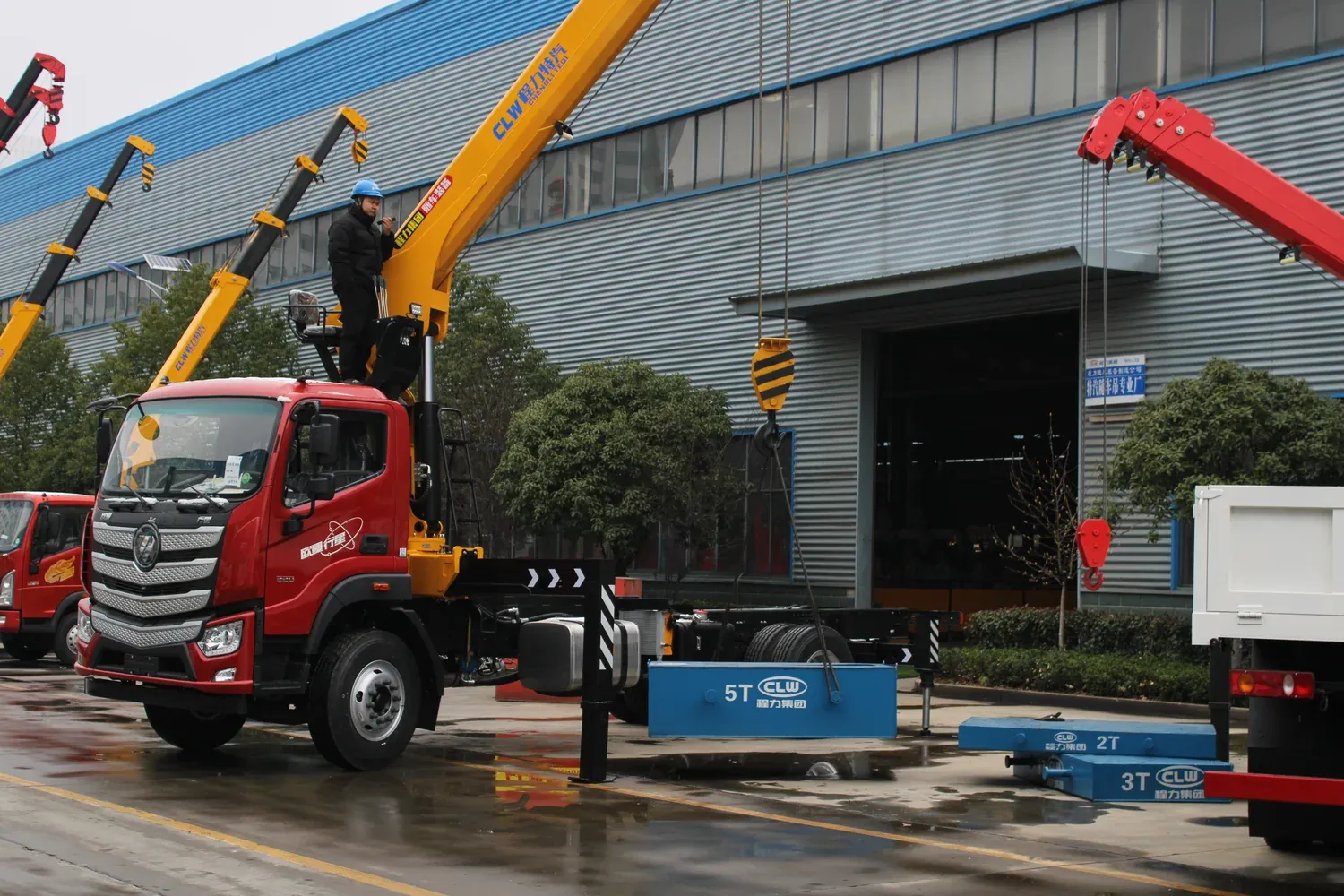
A crane is not assembled from parts. It is built in a sequence, and each step in that sequence determines what the crane can do for the next fifteen years. Nine steps, in this order. Here is what each one does, and why it matters.
Step 1 — Laser cutting
The boom and base sections start as steel plate, cut to shape. Laser cutting gives clean edges and consistent dimensions across a production run, which matters more than it sounds: every section that follows has to fit the one before it, and small variations accumulate.
Step 2 — Bending and forming
Flat plate is only a starting shape. Boom webs, frame rails and outrigger boxes are bent and formed on a press brake before anything is welded, and the bend has to repeat exactly from the first unit of a batch to the last. A bend that comes out wrong does not spoil only one part: the section will not close up correctly when it is welded, and the error carries into every unit that follows.
Step 3 — Boring, milling and grinding
Cut and formed parts become mating surfaces. Bores for pins and bushings are machined to tolerance, and surfaces are ground flat. This is the step that decides how much play the joints have — and play in a crane joint shows up as a wobbling load, ten years later, on a site nobody wants to visit.
Step 4 — Fit-up and welding
Sections are aligned and welded. Welding a crane is not the same as welding a trailer: the load path through a boom carries the full lifting moment, and the weld sequence controls how much distortion the section takes. Controlling distortion is cheaper than straightening it afterwards.
Step 5 — Shot blasting
Before any coating, the steel is shot blasted. This removes mill scale, rust and weld spatter, and it produces the surface profile that paint needs to actually grip. A coating applied over mill scale will look fine for a year and then fail in sheets.
Step 6 — Powder coating
The crane is powder coated electrostatically after blasting. Compared with conventional wet painting, powder coating gives a thicker, more uniform film and better resistance to chipping and corrosion — which is what a crane needs, because a crane on a working truck takes a lot more impact damage than a crane in a warehouse.
Step 7 — High-temperature curing
Powder coating is only half of a finishing process. Until it is cured, the powder is a dry film lying on the steel. Curing is what melts it, cross-links it and bonds it to the blasted surface as one continuous coating. A part that is coated but under-cured looks exactly the same on the day it ships — and fails within a season, usually a long way from the paint shop.
Step 8 — Modular assembly
Sub-assemblies — boom sections, outrigger legs, the slewing system, hydraulic components — are built and tested as modules before they go onto the main structure. Assembling modules rather than individual parts is faster, and it means a fault is found in a module rather than in a finished crane.
Step 9 — Final assembly
The modules are assembled onto the base, hydraulics are connected and the system is pressure-tested. Before delivery, every unit is load-tested.
Why we describe the process rather than the equipment
Any factory can list machine brands. What a buyer actually needs to know is whether the sequence is followed, and whether anyone is checking. That is what you verify on a factory audit — and it is why we tell you what to look for.
If you are auditing us, or any supplier
Paperwork tells you what a factory says it does. A factory visit tells you what it actually does. Three things are worth watching for — none of them requires anyone to produce a document:
Are the boom sections welded in a fixture, or freehand? A fixture controls distortion. Freehand welding puts the whole load path on the operator's eye.
Is the steel blasted before it is coated, or simply wiped down? Look at the surface immediately before paint. It should be uniformly grey and rough — not part-painted, not shiny.
Is each unit load-tested before dispatch? Watch the test. If nobody offers to show you, that answers the question too.
We are happy to arrange a factory inspection, in person or by video walkthrough. Contact us on WhatsApp at +86 158 0912 4321.