Oct 3, 2026
Wrecker Truck or Tow Truck: Boom, Winch and Underlift Explained
Lift, pull and tow come from three different pieces of iron. What decides the configuration, with published figures and a load chart for one FAW recovery build.
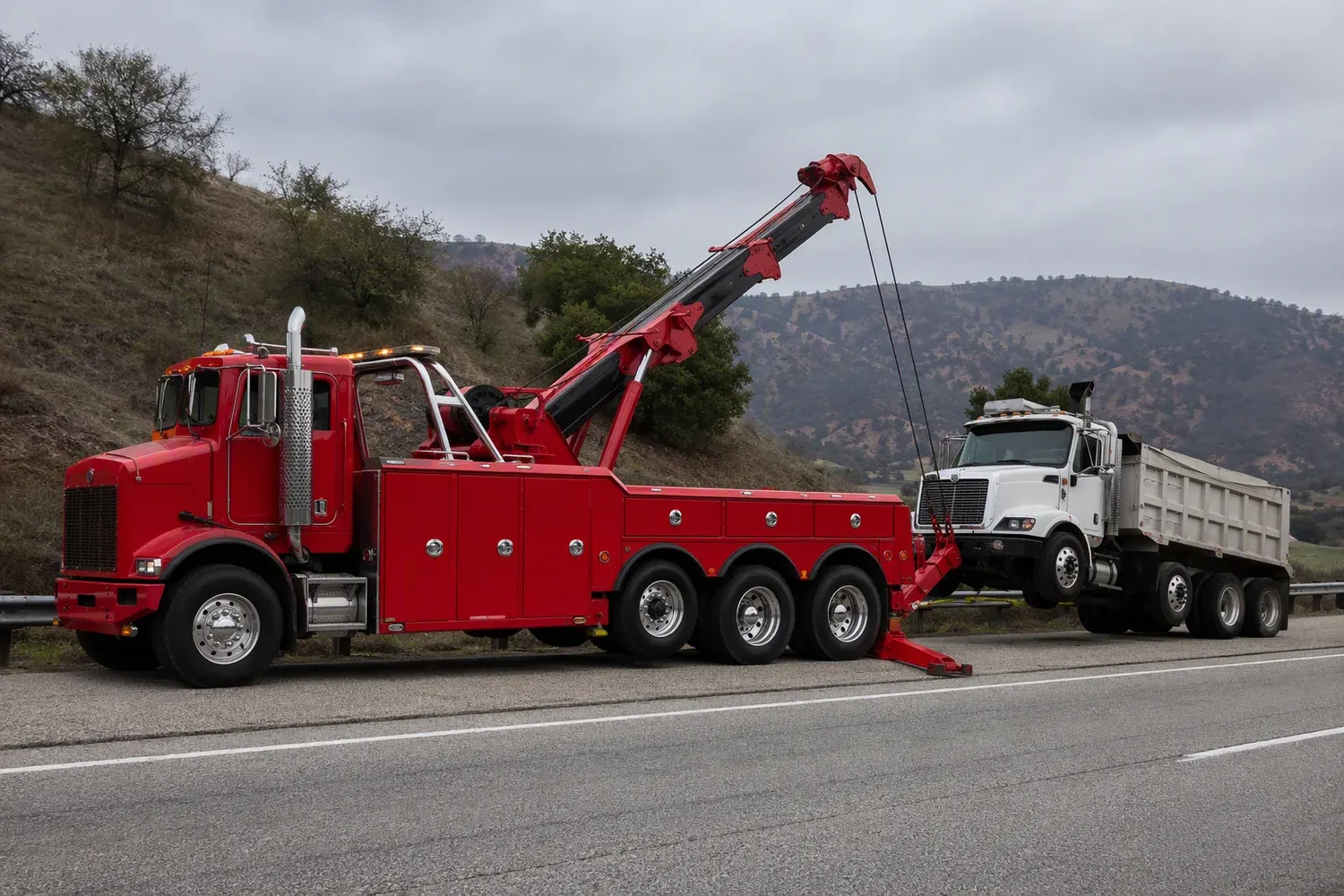
A tow truck that can only tow will be called out to a job it cannot finish. A recovery truck with a boom but no underlift will arrive at a casualty it cannot lift.
The three functions — lift, pull, and tow on the casualty's own wheels — come from three different pieces of iron. What you are actually buying is the combination.
Three functions, three pieces of equipment
Function | What does it | What it is for |
|---|---|---|
Lift and place | The crane: a telescopic boom with a hook | Recovering a unit from a ditch or a bank, lifting a load off, and positioning a casualty for the tow |
Pull | The winch | Dragging a casualty to the road when it cannot roll, and pulling a load onto the deck |
Tow with the casualty's wheels down | The underlift | Lifting an axle and towing the vehicle behind you — the function that makes a recovery truck a tow truck as well |
A flatbed tow truck carries the casualty on the deck. An underlift wrecker tows it on its own wheels. Both are legitimate answers, and the choice is usually set by the casualty mix: a fleet of vans and cars is flatbed work; a mixed fleet that includes trucks and buses needs an underlift, and needs a boom as well.
The build we publish, item by item
This is the specification of our FAW-chassis wrecker with crane, as listed on the product page:
Item | Published figure |
|---|---|
Chassis | FAW J6L 6x4 |
Wheelbase | 5,800 + 1,350 mm |
Engine | Dachai 320 hp (350 hp optional) |
Gearbox | Fast 10-speed, manual |
Drive axle | 435 pressed-welded |
Tyres | 12R22.5 |
Fuel tank | 400 L, steel |
Recovery body | 18 t, standard |
Winch | 10 t horizontal winch, optional |
Underlift | 18 t three-section, standard |
Flatbed | Sunken deck, 9.2 m total length |
Tail board | 1.2 m hydraulic folding, optional |
Stabilizer spread | 2,474 – 7,582 mm |
Crane | XCMG GSQS300-5, five-section telescopic boom |
Boom length | 5.47 – 18.63 m |
Max. lifting capacity / moment | 12,000 kg / 300 kN·m |
Max. outreach / lift height | 18.75 m / 20.5 m |
Slewing | 360° continuous |
Crane self-weight | 4,528 kg |
Note what is optional and what is not: the underlift and the 18 t recovery body are standard; the winch and the folding tail board are options. If you need the winch, it belongs in the order, not in a later retrofit.
The load chart is the real specification
The number "12 t" is not a description of what the crane lifts. It is the capacity at the shortest boom and the closest radius. The published chart for this crane tells the honest story:
Working radius | 5.47 m boom | 18.63 m boom |
|---|---|---|
2.5 m | 12,000 kg | — |
5.0 m | 6,400 kg (at 5.1 m) | 3,000 kg |
10.0 m | — | 1,800 kg |
18.0 m | — | 700 kg |
The same crane that lifts twelve tonnes at two and a half metres lifts seven hundred kilograms at eighteen metres. Both statements are true, and a supplier who quotes only the first one is not lying — they are just not answering your question.
This is why the load chart article on this site starts before the price does, and why the full chart travels with the quotation for this unit.
What actually sets the configuration
Ask these four questions before the model is chosen:
- What is the heaviest casualty, and what is its axle weight? An underlift is rated on the axle it lifts, not on the vehicle's total weight.
- Tow or carry? If the casualty's wheels and driveline are sound, tow it. If not, the deck is the answer.
- Must the boom reach over anything? A bank, a barrier, a wall. Reach and height come from the chart, not from the tonne figure.
- What does your road law allow in width and length? Stabilizer spread is 2,474 mm closed to 7,582 mm deployed on this unit — that is the footprint you need room for at the scene.
What we will not tell you
- We will not say one configuration covers a mixed fleet. A car-and-van operation and a truck-and-bus operation do not need the same rear end.
- We will not quote a lift without a radius. The chart above shows why.
- We will not treat the winch rating as a towing capacity. The 10 t figure is line pull, and towing capacity is a separate calculation based on what you lift and what you pull.
- We will not promise that a recovery body rating equals what your authority will register as a tow truck. Classification rules differ by country.
The one we build, and the one we would build for you
The unit specified above is listed on this site as the wrecker truck with crane on a FAW chassis. Cranes are either from our own production or sourced to your specification — available brands include WHHC, XCMG, SANY and Zoomlion — and chassis come from SINOTRUK, SHACMAN, Dongfeng, FAW Jiefang, Foton, Isuzu, JMC or JAC. We engineer the subframe, fabricate the body and deliver one finished, road-ready truck.
Left-hand drive is standard; right-hand drive is available on request and built to order. Options and body configuration are confirmed per order, as are the chassis and recovery-body figures for the specific build.
Send the casualty types and the axle weights on WhatsApp and we will tell you which combination of boom, winch and underlift you actually need — and which of the three you can leave off.