Oct 9, 2026
Importing a Crane Truck into Mexico: NOM First, Tariff Second
Mexico has no free trade agreement with China, and that is not what stops orders. NOM-044 is, and its current text is worth confirming before you order an engine.
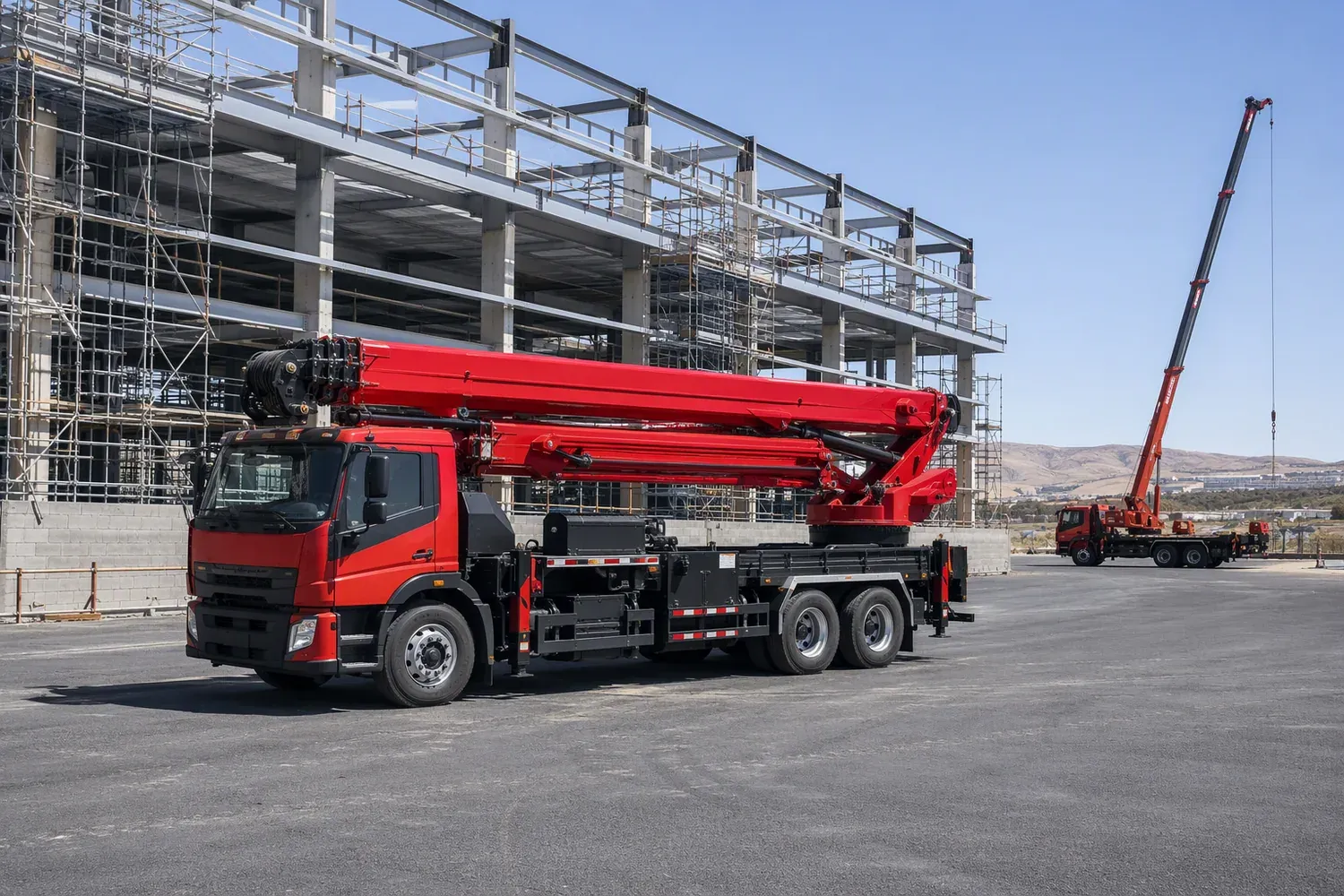
Mexico is the one large Latin American market where being the Chinese supplier costs you something at the border. There is no free trade agreement between China and Mexico, so a crane truck lands on most-favoured-nation treatment while a USMCA, EU or Japanese competitor's product can land at zero.
That is real, and it is not the thing that stops most orders. The thing that stops orders is NOM.
The tariff: a disadvantage you can calculate, not one you can argue
China is a most-favoured-nation origin for Mexico. USMCA partners, the EU and Japan have preferential access that we do not.
Because of that, the duty line matters more here than in almost any other market we serve. The rate is set per tariff fraction in the LIGIE — the Mexican tariff schedule — and it is read from the schedule, not from a conversation. We do not quote it. Ask the Mexican customs broker (agente aduanal) for four things in writing:
- The fracción arancelaria that applies to your vehicle as configured.
- The IGI rate on that fraction today for Chinese origin.
- The tax base treatment, so the IVA calculation is right.
- Any non-tariff requirement attached to that fraction.
Note that in Mexico value added tax is charged on the duty-paid value, so the duty figure moves the VAT base with it: get the sequence wrong when you build a landed cost and the error compounds.
NOM is the gate, and it has two faces
A crane truck entering Mexico must satisfy NOM standards and complete homologación. Two norms do the heavy lifting for our class of vehicle:
Standard | What it covers |
|---|---|
NOM-044-SEMARNAT-2017 | Emissions limits for heavy diesel vehicles — applies above 3,857 kg gross vehicle weight, which is every crane truck we build |
NOM-194 | Vehicle safety |
NOM-044 is not paperwork you attach — it is the specification of the engine and after-treatment you must order. The published revision associated with the current text moved the limits to Euro 6 / EPA 10 equivalent levels, effective 1 January 2025, which is a step above what many suppliers will offer you by default.
And here is the honest complication, which is worth more than a confident-sounding answer: an older reading of the same standard describes the earlier, less stringent stage. Before you order an engine package, have your Mexican certification body confirm the current text and the stage it applies today. If a supplier quotes you a Mexico-ready truck without knowing which version of NOM-044 it is being built against, that is not confidence — it is a gap.
Fuel: 15 ppm, but not everywhere
Mexico's diesel sulphur limit is 15 ppm under NOM-086 in the major metropolitan areas, the northern border zone and a further set of designated regions. Fifteen ppm is low-sulphur fuel, and it is compatible with the SCR and DPF after-treatment that Euro 6 / EPA 10-class engines use.
The catch is geographic. If the truck will work outside the designated low-sulphur zones, confirm the sulphur level of the fuel actually delivered to your site — not the national specification. A modern after-treatment system specified for 15 ppm and fed something else is a maintenance problem that arrives months after delivery.
This is why the emission question and the fuel question belong in the same conversation, and why the Euro 6 and China VI article on this site refuses to state a stage without knowing the fuel.
New versus used: the rules are not the same
New vehicles have no quota, but they must meet NOM. Used imports are handled under a separate regime: an environmental-conditions agreement, an age window expressed in model years, and an additional ad valorem charge for the applicable window.
We supply new trucks and we do not publish the used-vehicle windows or charges — they are a different business with different rules, and your broker is the right source. If you are comparing a new import against a used one, make that comparison on a landed-cost basis that includes homologación, because the certification path is not the same for the two cases.
What we will not tell you
- We will not quote a Mexican duty rate. The fracción and its rate come from the LIGIE, read by your broker.
- We will not claim a China VI test report satisfies NOM-044's Euro 6 / EPA 10 requirement. Equivalence is determined by the Mexican certification path, not by us.
- We will not state the homologación process, cost or timeline. We have not verified it and will not estimate it.
- We will not promise a port, a transit time or a registration outcome.
What to confirm before you order
Three lines, in this order:
- Which version of NOM-044 applies today, and what engine evidence the certification body accepts for it.
- Your fracción arancelaria and its IGI rate for Chinese origin, plus the IVA sequence.
- The fuel sulphur level where the truck will actually work.
Answer those and the specification writes itself: the emission package follows from (1) and (3), and the commercial decision follows from (2). Left-hand drive is our standard build, which is what Mexico registers — no steering conversion is involved. Right-hand drive is available on request for other destinations.
Our truck-mounted crane and grab truck listings carry the full range with the technical documentation we can supply for a certification file. Models and figures quoted in this article are those currently listed on this site, reviewed 1 October 2026.
Mexico's industrial construction and manufacturing logistics demand has been growing with the nearshoring wave, and that is a genuine opening for equipment in the 3–12 tonne crane class — but only for suppliers who can produce the emission evidence the norm now demands.
Send us the three answers on WhatsApp and we will come back with the model and the documentation list.