Oct 1, 2026
Importing a Crane Truck into Peru: Homologación First, Euro VI-A Second
Peru's binding obstacle is not the emission stage — it is a homologación number issued in Lima before the truck sails. The Euro VI-A obligation is real and currently unsettled.
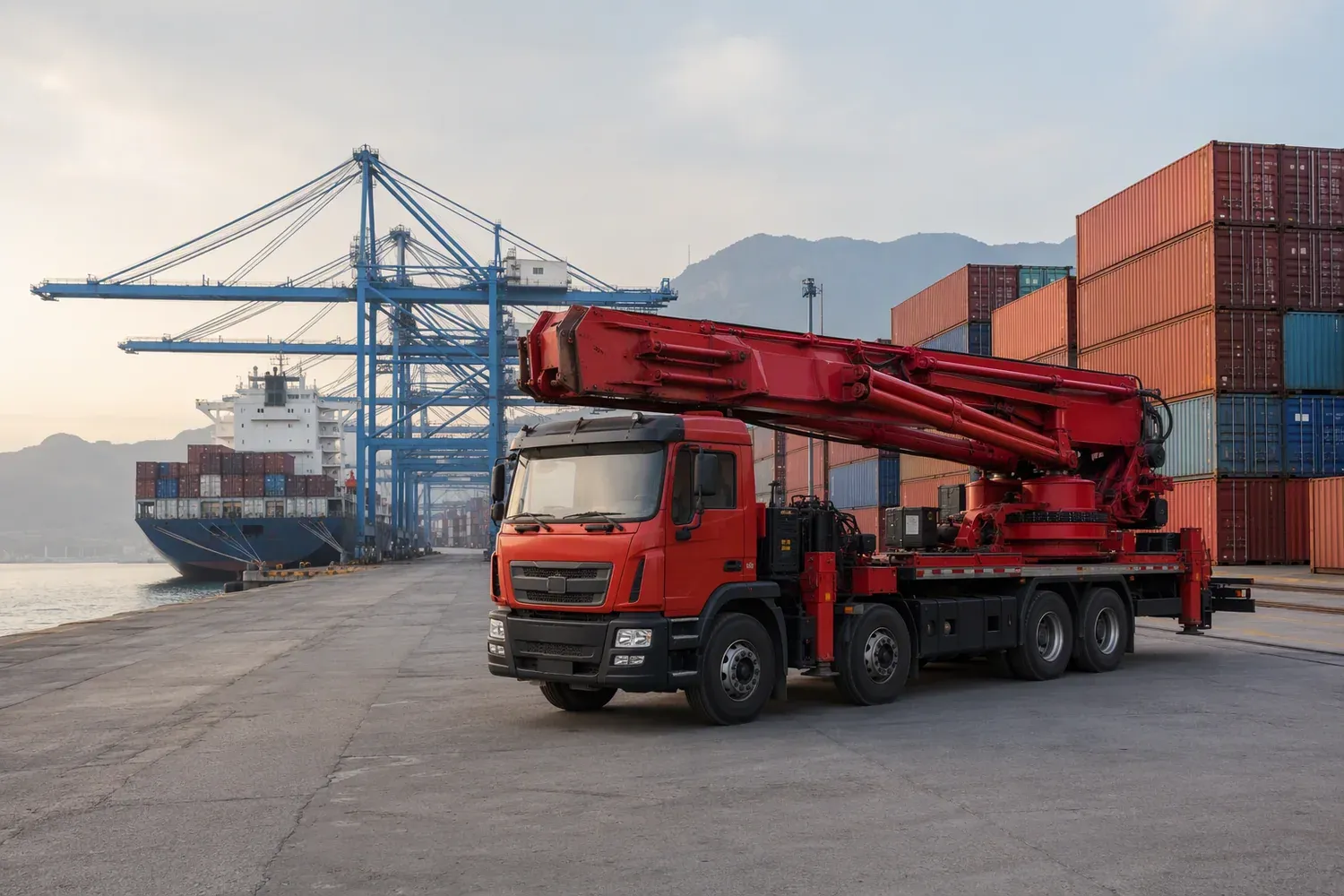
Everyone asks about the emission stage. In Peru the emission stage is not what stops the truck.
Two crane trucks can arrive at Callao with identical engines and identical paperwork, and one clears while the other sits in storage. The difference is a registration number that is issued in Lima, to a party in Peru — and it has to exist before the truck is loaded, or at least before the declaration is filed.
The gate is a homologación number, not an engine
Peru requires homologación vehicular — vehicle type approval, handled by the Ministry of Transport under the VUCE code MTC001. SUNAT, Peru's tax and customs administration, is explicit that without a valid homologación the vehicle is not released.
That is not a document you attach after arrival. When the customs declaration (DAM) is filed, it must carry:
- the VIN,
- the Registro de Homologación number, and
- the registrable characteristics set out in Anexo V.
And if the importer is not the party that holds the homologación, they must file either proof from the manufacturer or its Peruvian authorised representative, or a Certificado de Conformidad de Cumplimiento issued by a certification body authorised by the MTC.
The practical consequence is the one that matters commercially: the type approval has to be started on the Peruvian side, by a party that can hold it. An exporter in China cannot file it. If your importer has never homologated this model, the clock starts with them — not with the ship's departure.
"New vehicle" has a narrow definition
Peru does not treat "new" as a matter of opinion. Under DS 019-2018-MTC, a new vehicle means:
Requirement | Condition |
|---|---|
Model year | The year of the customs declaration, the following year, or at most two years earlier |
Odometer | 150 km or less |
Prior registration | Never registered in the country of export |
A demonstration unit that has been registered abroad, or a truck with 3,000 km on it, is not a new vehicle in this sense regardless of its condition. That changes both the duty treatment and the paperwork.
The emission question is real — and currently unsettled
This is the part where the honest answer is "it depends on a decree that is still in dispute".
The background, as compiled by the technical database DieselNet from Peru's DS 029-2021-MINAM and related rules:
- Heavy new vehicles: Euro IV from April 2018.
- Euro VI-A from April 2026, tested on WHSC and WHTC cycles.
The date is not arbitrary. DS 003-2024-MINEM ties the Euro 6/VI obligation to six months after low-sulphur fuel becomes available, and that fuel milestone is dated 1 October 2025 — which is where April 2026 comes from.
Then the dispute. On 20 July 2026, Peru's automotive association (AAP) publicly asked the government for a postponement decree, on the ground that fuel supply had not followed the deadline. Whether that postponement has been granted is not something we can confirm — and we are not going to state the position as settled in either direction.
So the question to ask is a local one, and it should be asked before you order:
"Can a Euro V heavy truck be homologated and cleared in Peru today?"
If the answer is yes, the specification range widens. If it is no, the chassis has to be Euro VI-A or equivalent — and whether a China VI test report is accepted as equivalent is decided by the MTC-authorised certification body, not by us and not by the engine supplier.
Fuel: 10 ppm sulphur takes one risk off the list
Peru's diesel sulphur limit is 10 ppm, mandatory nationwide from 1 October 2025, and the term is stated as not extendable (DS 003-2024-MINEM). Diesel B5, with Loreto and Ucayali excluded from the same supply assumption.
For a crane truck this is good news rather than a constraint. Low-sulphur fuel is what SCR and DPF systems are designed for. Peru is not a market where you need a mechanically-injected fallback to survive high-sulphur diesel — that whole category of workaround does not apply here.
Duty and tax: what is confirmed, and what only your broker can give you
Item | Status |
|---|---|
Import duty | The China–Peru FTA (in force since 2010) reduces most industrial goods to 0%, and vehicles are not among the roughly 592 excluded products (textiles, apparel, footwear and some metal machinery). The benefit requires a Certificate of Origin. |
Duty, per line | The current rate for the exact tariff line must be read off the live Arancel by a customs broker. We do not quote a duty number. |
IGV | 18% (16% plus 2% municipal promotion tax). |
Tax base | IGV is charged on CIF plus duty — a sequence that is often missed when buyers estimate a landed cost. |
ISC (excise) | Whether trucks are subject to it, and at what rate, must come from a broker reading the current Apéndice IV. We do not publish a figure. |
Registration taxes and documents | Not verified on our side. |
Ports and terms
Callao is the main destination port; Paita, Salaverry, Matarani and Ilo are the alternatives. We quote CIF to the port you nominate, and inland transport inside Peru is arranged by the buyer.
What we will not tell you
Six things are on our "do not state" list for Peru, and they are the six things most often asserted by others:
- The exact current duty rate for the truck's tariff line.
- Whether ISC applies to trucks, or its rate.
- The registration documents and registration taxes.
- Sailing schedules, transit times, RoRo or flat-rack lashing requirements.
- Whether the Euro VI-A obligation has been postponed — unresolved, and we say so.
- Whether a China VI test report will be accepted as equivalent by the MTC — that is the certifying body's decision.
We also do not promise that homologación will be granted. It is a type-approval decision made in Peru about a specific model.
What to confirm before we quote
Two questions decide whether this is a straightforward order or a project:
- Does your importer already hold, or can it obtain, the homologación for this model? If not, who is the MTC-authorised representative?
- Is Euro VI-A being enforced for heavy new vehicles today in the port and registry where you operate?
Answer those two and we will quote the chassis and crane class that fit your answer. Left-hand drive is our standard build — Peru is a left-hand-drive market, so no steering conversion is involved — and emission class is selected per order, not assumed.
Official reference
- SUNAT, vehicle import information: https://www.sunat.gob.pe/customsinformation/importofvehicles/index.html (homologación requirements, DAM fields, FTA and IGV treatment)
- DS 019-2018-MTC (definition of a new vehicle); DS 029-2021-MINAM (emission stages); DS 003-2024-MINEM (low-sulphur fuel trigger and the 10 ppm limit)
- Emission timing compiled by the technical database DieselNet, Peru country page — not a government publication, which is why we attribute it as a compilation
Rules change, and the enforcement position in Peru has changed within the last year. Confirm the current position with your customs broker and the MTC-authorised certification body before you order. If you want the specification of a crane truck that fits a Euro VI-A or a Euro V path, we can quote both.