Sep 30, 2026
Mechanical Control or Electronic Control? The Fuel System Choice That Decides If Your Grab Truck Is Still Working in Five Years
Both Euro III and China VI diesels are direct-injection. The real distinction is mechanical versus electronic control — and on high-sulphur fuel in thin-service markets, that decides downtime.
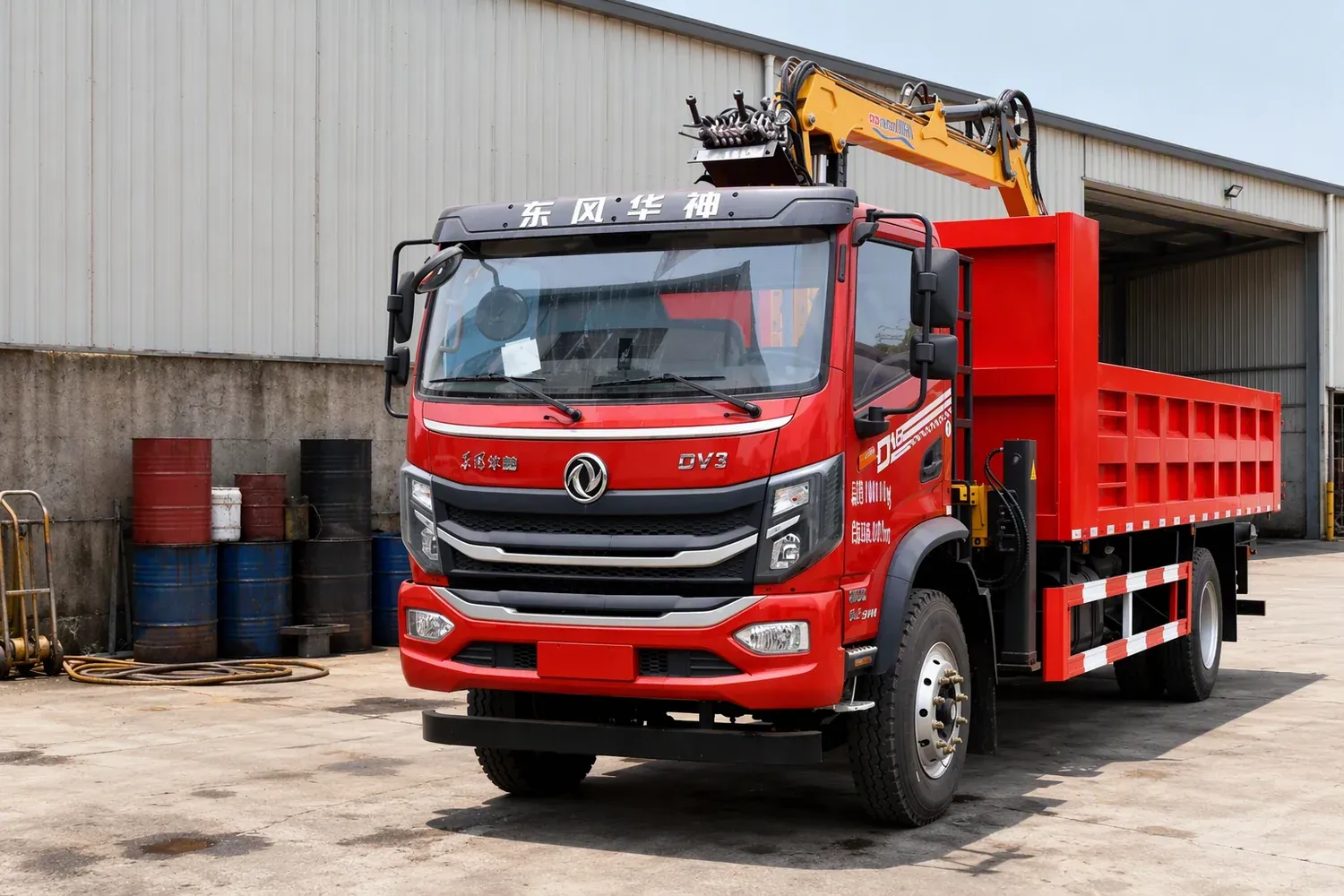
Most grab truck quotations argue about boom length and grab type. Those decide whether the machine does the job today.
The fuel system decides whether the machine does the job in five years — and it is the part of the specification buyers most often leave to the supplier.
This page is about that choice, and it starts by fixing a piece of terminology that most suppliers get wrong.
Our position, up front, so you can weigh it as you read: we recommend the mechanically controlled path for markets with high-sulphur fuel and thin service coverage, because it is the more reliable machine to own and the far easier one to repair. Not because it is cheaper, and not because it is older technology — but because it has fewer things that can stop your truck. The rest of this page is the reasoning, including where that recommendation does not apply.
First: "direct injection versus electronic injection" is not a choice
You will see this comparison all over the trade. It is wrong, and you should be suspicious of anyone selling with it.
Almost every diesel engine in this class injects fuel directly into the cylinder. That is what direct injection means. A Euro III engine and a modern China VI / Euro VI engine are both direct-injection engines.
The real difference is how the injection is controlled:
Mechanically controlled | Electronically controlled | |
|---|---|---|
How timing and quantity are set | By a mechanical pump and governor, driven by the engine | By an electronic control unit reading sensors |
Fuel metering | Mechanical, fixed relationships | Calculated continuously, per cylinder |
Fuel pressure | Mechanical pump pressure | High-pressure common rail, far higher |
Sensors needed to run | Essentially none for fuelling | Rail pressure, air mass, temperature, and on later stages exhaust sensors |
Exhaust after-treatment | None | SCR (AdBlue), often DPF and EGR |
Emissions class typically | Euro II / Euro III | Euro V / Euro VI |
Two things are correlated here but they are not the same thing: the control method (mechanical or electronic) and the emissions class (Euro II…Euro VI). They usually travel together, but they are separate questions, and a buyer who conflates them will make one of two expensive mistakes — buying a machine that cannot be registered, or buying a machine that cannot be repaired where it works.
Keep them separate. The rest of this page is about the first one.
What a mechanically controlled system does not have
This is the whole argument, and it is a list of absences:
- No electronic control unit. No computer to fail, and none to replace.
- No common-rail high-pressure pump. A common rail injects at pressures several times higher than a mechanical pump, through components machined to very fine tolerances. Those clearances are what make it efficient and what make it fragile.
- No sensor suite required to run. No rail-pressure sensor, no air-mass meter, no exhaust sensors. Each is a component that can end the day.
- No AdBlue, no SCR, no DPF. No reagent to buy, no tank to freeze or contaminate, no filter to load up.
- No diagnostic handshake. Nothing that requires a dealer laptop to tell a workshop what is wrong.
The claim, stated plainly
So here is what we tell every buyer who asks, and we are willing to put it in writing:
A mechanically controlled engine is safe and dependable in the conditions it is specified for, and it is easier to repair than an electronically controlled one. That is not a marketing line; it is the direct consequence of the list above. Reliability, in a working truck, is mostly a count of failure points — and this engine has fewer of them. Repairability is mostly a question of what tooling the job needs — and this engine needs hand tools, not a dealer laptop.
What we will not claim is that it is better in every market, or that it needs no servicing. A reliable truck is still a maintained truck. Where the fuel is clean and the workshop network is close, the electronically controlled engine is the better machine and we say so below.
Why that matters where fuel and workshops are the constraint
Sulphur. Sulphur in diesel is a problem for two things: the precision fits inside a high-pressure fuel system, and the exhaust after-treatment. A mechanically controlled pump with coarse tolerances degrades gracefully on high-sulphur fuel. A common-rail system plus SCR and DPF does not — and downstream of them sits a vehicle that will not run correctly, and often will not run at all, when they are unhappy.
Repair. A mechanical pump can be worked on by a diesel fitter with hand tools and a test bench — a skill that exists in almost every town in every market we sell into. An electronically controlled system needs the right diagnostic tool, the right software, and often the right part, which for a Chinese commercial vehicle in a remote market can mean a wait measured in weeks.
The downtime arithmetic. This is the part that gets lost in a fuel-consumption comparison. An electronically controlled engine will generally use less fuel. But a machine that stands for three weeks waiting for a sensor has not saved fuel — it has lost the work. On sites where the alternative machine does not exist and the material still has to move, that asymmetry usually decides the purchase, and it is the reason this option keeps being specified.
The other side, stated fairly
We build both, so we will not pretend one is always right.
Electronically controlled engines are better where:
- The fuel is genuinely low-sulphur and reliably so.
- The market requires a modern emissions class to register the vehicle.
- A dealer network and diagnostic tools exist within reach.
- Fuel economy is a material cost line, because the machine works long hours.
If all four of those are true for you, an electronically controlled engine is the correct specification and we will tell you so.
Mechanically controlled engines are the better fit where:
- Sulphur is high, or the quality of what you get varies.
- The nearest workshop that can talk to a modern engine is far away, or does not exist.
- Parts availability, not purchase price, is your real risk.
- Your market's registration rules still admit a Euro II / Euro III class vehicle.
The problem you must solve before the engine question
A mechanically controlled engine is a Euro II / Euro III class machine, and some markets will no longer register one. This is not negotiable and it is not something a supplier can talk around. Here is what we have been able to verify, with sources, as of 2026-09-30: [^1]
Market | Emissions requirement | Could a Euro II/III unit be registered? | Diesel sulphur |
|---|---|---|---|
Kenya | EURO 4 or above | No — blocked by the requirement | 50 ppm |
Nigeria | ECOWAS regional standard: Euro 4 / IV | No, on the regional text | ~650 ppm (Reuters, non-official) |
South Africa | Euro 2 / Euro II (no update since 2006 — ICCT) | Yes in principle on the emissions rule | 500 ppm standard, 50 ppm low-sulphur (SANS 342) |
Ghana | Euro II (non-official — no official text located) | No barrier located | 50 ppm (NPA, official) |
Tanzania | No published emissions requirement located | No barrier located | 50 ppm |
Bolivia | Euro II | Yes in principle | 500 ppm |
Morocco | Not verified | We cannot say | 10 ppm — the cleanest in Africa |
Egypt | Not verified (conflicting sources) | We cannot say | Not verified (sources conflict) |
Read the last two rows as carefully as the first two. Where we could not verify a requirement, we are not going to invent one — and we will not tell you a machine will pass an inspection we cannot describe.
Two conclusions fall out of that table, and they point in opposite directions for different customers:
- South Africa is the clearest example of a market where the "modern" engine is the wrong machine. Its emissions rule has not moved since Euro 2, while its standard diesel is 500 ppm sulphur — a combination that is hard on after-treatment and easy on a mechanical pump. The market is asking for Euro II-class vehicles and supplying high-sulphur fuel to run them on.
- Kenya and Nigeria close the door on the mechanical option outright. If you sell into those markets, the choice is made for you, and the answer is an electronically controlled engine and compliant fuel.
Where the choice actually sits in our supply chain
Here is the part that buyers do not expect, and it is the reason this must be decided early.
In our build programme, a mechanically controlled engine is not an engine option on every chassis. It comes as a package with the chassis family. The chassis range we normally specify for export grab trucks does not offer a mechanically controlled variant; the mechanically controlled option sits on a different chassis family.
That has two consequences for you:
- You cannot decide the engine after choosing the chassis. Ask about the engine first, then the chassis follows.
- Comparison is not "same truck, two engines". It is two different trucks at two different prices, with different bodies, wheelbases and axle ratings.
We build left-hand and right-hand drive on both paths. Steering side is a separate question from the engine and is decided by your market, not by this choice.
One more thing about the chassis, because it is what buyers ask next. Your chassis comes from Dongfeng, and Dongfeng's overseas commercial-vehicle business operates an official export arm with a published overseas service network and parts commitments. We confirm the warranty term and coverage for your specific chassis and market in writing before you order — we will not quote you a warranty period off a web page, because the different Dongfeng entities do not publish the same policy. We have set out exactly what is documented and what is not on a separate page about service and warranty.
What we will not tell you
- Engine model, displacement, power or torque figures. We are not going to print a designation and a number here and then ship something else. Ask for your build and you will get the engine that is actually going into it.
- How many years or kilometres it lasts. Anyone who gives you that number is inventing it. Service life is decided by fuel, load, driving and maintenance — none of which we control after delivery.
- A percentage fuel-consumption difference. It depends on duty cycle. A single figure would be misleading, and we would rather say that than give you a number to argue with.
- That a mechanically controlled unit will pass your market's emissions test. We have told you what we could verify about the rules. Passing an inspection is a matter for your market and your importer.
- A price difference between the two paths. Different chassis, different body, different machine. Ask for a quotation on each and compare machines, not components.
The four questions we will ask you
Before we quote either path, we need:
- What is the sulphur content of the diesel you can actually buy — not the national standard, the fuel at the pump you will fill from.
- How far is the nearest workshop that can diagnose a modern electronically controlled engine — in hours, not kilometres.
- What emissions class your market requires to register a new grab truck — if you do not know, ask your importer before you ask us.
- How many hours a day the machine will work — because that is what makes fuel economy either decisive or irrelevant.
Answer those four and we will recommend a path and explain why. We have no interest in selling you the wrong one: a machine that cannot be registered, or cannot be repaired on your site, costs us a customer.
Not sure which fuel system your market and your fuel actually call for? Tell us the country, the sulphur content you can buy, and how far away your nearest engine workshop is. We will tell you which path fits and which one we would refuse to ship you.
[^1]: Emission and fuel figures are drawn from the sources named in the table. Where a figure is marked non-official it comes from a third party and we have said so rather than present it as a regulation. Where we could not verify a requirement, the table says so.
Rules, standards and fuel specifications change. Verify with your local importer and registration authority before you order. This page describes how we build and what we will and will not commit to; it is not a statement of your market's legal requirements.