Oct 1, 2026
Grapple Truck or Grab Truck: The Same Machine, Three Names
A grapple truck, a grab truck and a truck mounted grabber are the same machine — and only one of the three quotations that come back is for a truck. The six lines that make two quotes comparable.
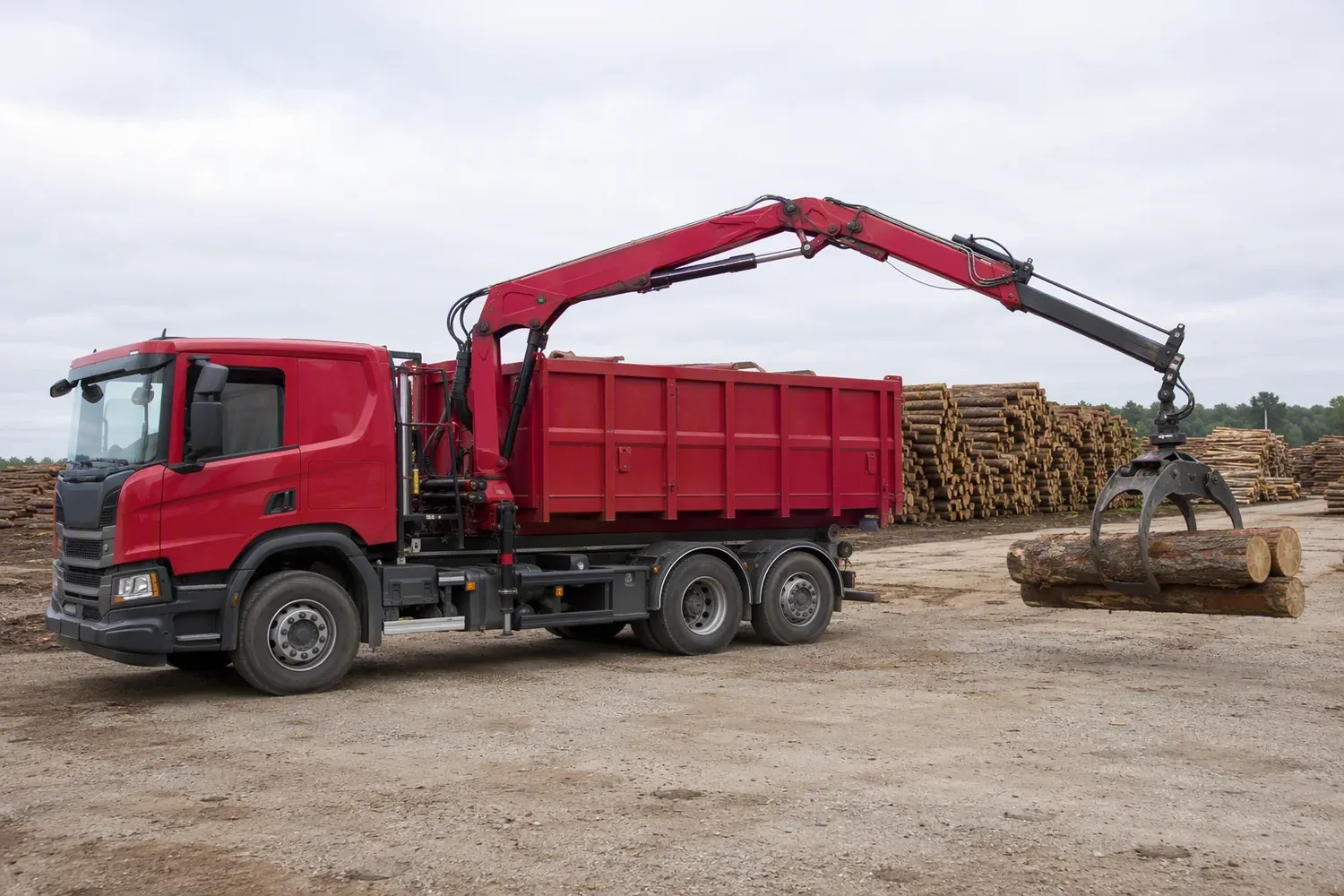
A buyer in Texas asks for a grapple truck. A buyer in Lagos asks for a grab truck. A buyer in Jakarta asks for a truck mounted grabber. Three quotations come back from three suppliers and only one of them is for a complete truck — the other two are for a boom, or for the grab head on its own.
Nothing went wrong. The machine has no single name in the trade, and the vocabulary a buyer uses is a reliable signal of which market their quotation came from.
Four vocabularies for one machine
Term | Where it is used | What the buyer usually means |
|---|---|---|
Grab truck / truck mounted grab | UK-facing and Asian trade listings | A complete truck: chassis, knuckle boom, grab head |
Grapple truck | North America | Same machine, often assumed to be for logs, brush or refuse handling |
Truck mounted grabber | Trade-listing shorthand | Usually the complete unit; sometimes only the boom with the head |
Timber grab / log grapple / scrap grab | Everywhere, specified by material | The same base machine, defined by what it handles |
随车抓 (Chinese, "crane truck with grab") | The source term behind most quotations | A crane truck whose hook is replaced by a grab |
Searching either of the first two terms on the trade platforms returns a substantially different supplier list. The "grab" pool fills up with attachment and forestry-equipment makers; the "grapple" pool mixes those with crane and vehicle builders. Both sets are real suppliers. Only one set builds the truck.
Why the wording costs money
An incomparable quotation is worse than a slow one, because it gets approved. The three ways the same request goes wrong:
- Boom only. A price for the knuckle boom and grab head, with the chassis excluded. The buyer then discovers the chassis is the larger line item.
- Head only. A price for the grab head and rotation, to be mounted on a truck the buyer already owns — a valid purchase, but a different project.
- Vehicle but not the body. A truck with the crane, no deck or body decision made. The body, the deck length and the tipping arrangement are then negotiated after the order.
The six lines that make two quotations comparable
Ask for these in writing, in this order. Any supplier who cannot answer all six is not quoting the same machine as the next one.
Line | Why it decides the price |
|---|---|
Chassis and drive form | 4x2, 6x2, 6x4, 8x4 — sets GVW, axle load and the maximum boom that can be mounted |
Boom sections and reach | Our grab line runs 8.2 m to 12 m; sections and reach are not interchangeable |
Grab head type | Universal, timber, flat-jaw or magnet — different heads, different work |
Linkage | Soft or rigid linkage changes how the head behaves under load, not just its cost |
Body | Dump body or platform, and the deck length you actually need |
Winch | Fitted or not; it changes what the unit can pull as well as lift |
Head types, in one table
Head | Use it when |
|---|---|
Universal 3+2 | Mixed yard work: loose, mixed and irregular material |
Timber / 2+2 | Logs and long material where the load has to be held in line |
Flat-jaw | Flat and stacked material, and where the load must not be dented |
Magnet | Ferrous scrap where a grab would drop the small pieces |
Boom with winch | The job also needs pulling or lifting on a hook |
Our complete units in the truck-mounted grab line run from 6.3 t to 12 t on 4x2, 6x2, 6x4, 8x4 and 4x4 chassis. Two examples at opposite ends: the 6.3 t unit on a Dongfeng Huashen DV3 with a 3+2 grab and the 12 t log grab on an 8x4 Dongfeng D7V.
Two naming traps worth knowing
"Grab" does not tell you the linkage. Two trucks sold as the same type can differ in whether the head is on soft or rigid linkage — a real distinction with its own consequences, covered in a separate article on this site rather than repeated here.
A grab truck is not a crane truck with a different word. They are different machines with different uses and different buyers. If your material arrives by hand or by machine and has to be held in transit through the cycle, you want the grab. If it arrives on a pallet or in a sling, you want the hook — see the truck-mounted crane line.
What we will not tell you
- We do not publish a grab's gripping force or jaw opening. Those are head-specific figures and they come from the head supplier with the quotation.
- We will not tell you one head suits all material. Flat-jaw on loose scrap and a magnet on mixed turnings are not the same purchase.
- We will not quote a price for "a grab truck" without the six lines above. The answer would be a number, not a truck.
What to send us
Send the material, the truck's working environment, the drive form your roads and axle rules allow, and the deck length you need. Those four answers pick the head, the boom and the chassis together. Left-hand drive is our standard build and right-hand drive is available on request; emission class is confirmed per order and per market.
Model names, boom lengths and grab types on this page are the ones currently listed on this site, reviewed 1 October 2026.
WhatsApp us a photo of the material and the yard and we will name the head in your own vocabulary.