Oct 1, 2026
5 t to 16 t: Choosing the Crane Class and the Chassis It Needs
The tonnage on the crane is not the tonnage the truck can carry, and it is not what you can lift at the end of the boom. How crane class, payload and axle load set the answer.
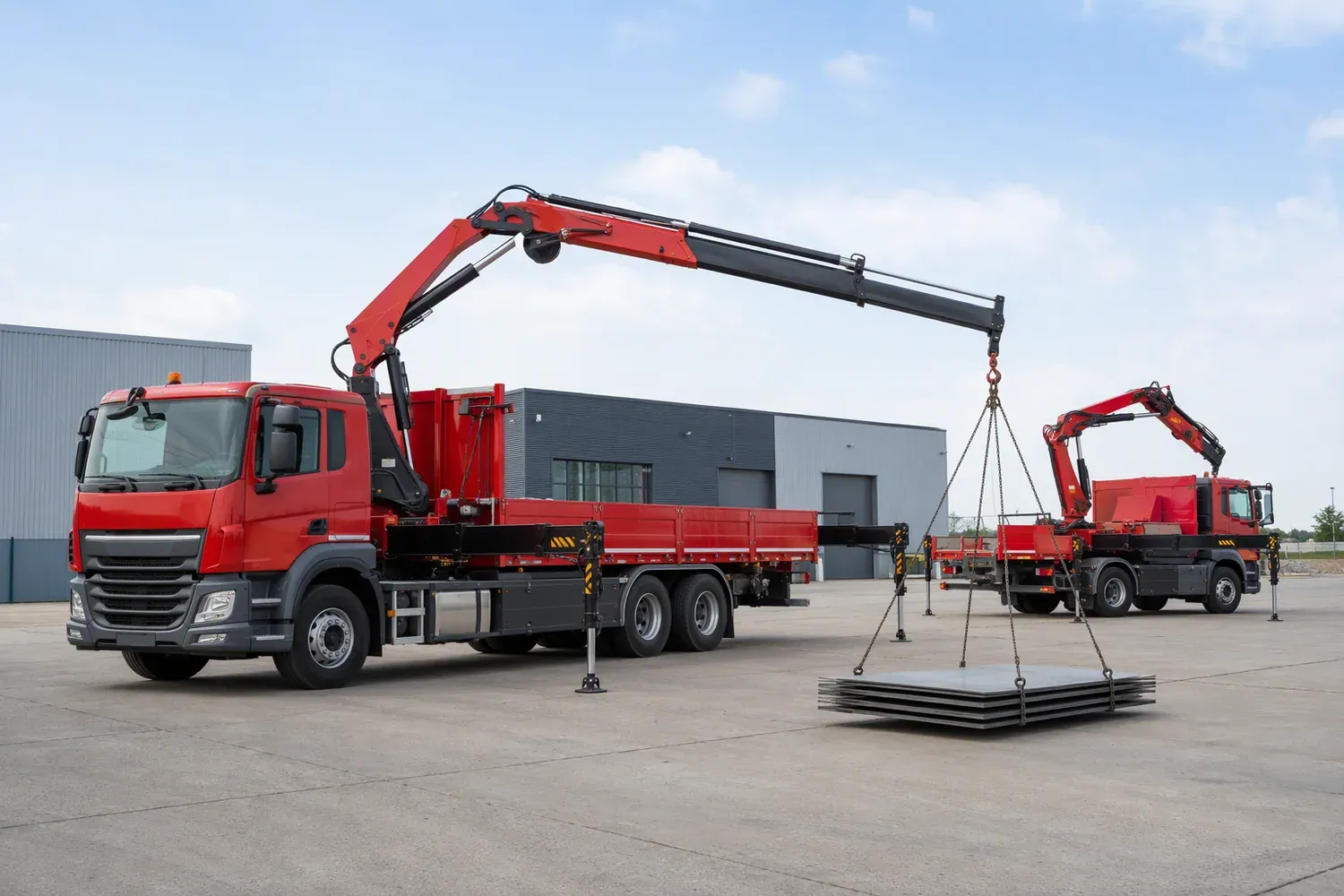
The tonnage on the crane is not the tonnage you can lift at the end of the boom, and it is not the tonnage the truck can carry. Three different numbers wear the same word, and the class you need is set by the smallest of them.
This is why two quotations for "a 12 t crane truck" can differ by the price of a second truck — they are describing different vehicles.
Two numbers, one word
Crane class is a rating for the crane: the maximum moment it can generate, expressed as a load at a defined radius. Move the load further out and the permissible load falls — that relationship lives in the load chart, not in the tonne figure.
Payload is a rating for the truck: gross vehicle weight minus what the truck weighs with the crane, the body and the equipment on it. On a crane truck this is usually the binding constraint, because the crane, the stabiliser legs, the subframe and the body all sit inside the payload budget before the first tonne of cargo goes on.
A published example from our own line makes the arithmetic concrete. On the Dayun 6x2 lifting-axle crane truck:
Item | Published figure |
|---|---|
Gross vehicle weight | 24,500 kg |
Curb weight | 13,725 kg |
Rated payload | 10,645 kg |
Axle load (front / rear) | 6,500 kg / 18,000 kg |
10,645 kg is the whole cargo and equipment budget. A 10–12 t crane class on that chassis is not speculative — but the body, the outriggers and the deck are already paid for out of the same budget.
The class ladder we actually build
Crane class | Boom | Chassis examples we list |
|---|---|---|
5 t | 4-section telescopic | Isuzu 4x2, HOWO, Foton, Dongfeng 4x2 |
8 t | 5-section telescopic | Qingling 5-section; WHHC SQS200-5 |
12 t | 5-section telescopic | SHACMAN 5-section; WHHC SQS300-5 |
14 t | 5-section telescopic | WHHC SQS350-5 |
16 t | 5-section telescopic | Isuzu, SITRAK, WHHC SQS400-5 |
Model codes carry the crane's own rating: SQS200-5 is a 200 kN·m, 5-section crane; SQS400-5 is the 400 kN·m class. The boom sections and the class are declared in the model name so that two quotations can be compared without a phone call.
There is also a parallel line where the crane is not the point: the Dongfeng DFL5140 4x2 and DFL1250 6x4 are chassis listed for crane mounting, where the crane is selected to the job rather than carried in stock.
Why the same crane lands on different chassis
Three chassis decisions set the answer before the crane is chosen:
Axle load. Every market caps what each axle may carry. On the Dayun above, the front axle is limited to 6,500 kg and the rear group to 18,000 kg. A crane and its outrigger reaction sit behind the cab on some builds and over the rear axle on others, and that single choice moves the load between two very different limits.
Frame. The mounting frame has to take the crane's moment, not just its weight. The Dayun carries a 300 × (8+8+6) mm three-layer through-frame. On lighter chassis the subframe becomes the deciding component.
Wheelbase and body. A crane mounted behind the cab leaves a short cargo deck and shifts weight forward; mounted behind the rear axle it leaves a longer deck and puts more onto the rear group. Neither is wrong — they are different trucks.
Where the classes actually land in service
- 5 t on 4x2. Short deck, city and yard work, one operator, quick cycles. The most commonly mis-specified class, because it is quoted for jobs that then grow.
- 8 t to 12 t on 6x2 or 6x4. The general-purpose band: containers, steel, building materials, machinery, with a working deck that is still useful.
- 14 t to 16 t on 6x4, 8x4 or a semi-trailer. Structural lifting and heavy cargo, where the crane is the reason for the truck rather than an addition to it.
If the job is lifting rather than carrying, the arithmetic inverts and the 38 t knuckle boom crane on a SHACMAN M3000S 6x4 tractor is the same principle taken further.
What we will not tell you
- We will not publish payload or axle-load figures for a configuration we have not weighed. Where a listed model carries a range instead of a single figure, that is deliberate: the range belongs to the crane options, not to one truck.
- We will not convert a crane class into a lift at a radius. That number is on the load chart, and the load chart comes with the quotation.
- We will not promise a registration or certification outcome in your market.
What to send us instead of a tonnage
Tell us the load, the radius, the material and the deck length you need, and whether the truck will mostly carry or mostly lift. Those five answers set the class and the chassis together — and if the honest answer is "one size up", we will say so before you order rather than after.
Drive side and emission class are confirmed per order and per market: left-hand drive is our standard build and right-hand drive is available on request. Models and figures on this page are those currently listed on this site, reviewed 1 October 2026.
Send us the load and the radius on WhatsApp and we will come back with the class, the chassis and the load chart.